www.weldreality.com
Ed Craig’s. Flux Cored (FCAW) Weld Quiz.
30 Fundamental FCAW Process Control - Best Practice Questions..
.jpg)
Imagine being in charge of a weld shop in which the gas shielded flux cored weld process is commonly used. As you walk around the weld shop you start to think about the weld rework costs with those last stainless and carbon steel tanks and pipes. One thing that bugs you is you don't feel confident that you have a complete grasps of the real weld costs daily being generated in the weld shop. Also you are aware that most of the weld personnel in the shop have for years "played around" with their MIG and Flux Cored weld controls, and you wonder how this affects your daily weld quality, productivity and costs.
The next weld job your company will have will require API - ASME weld code requirements. NDT will be used on all the weld joints. You know that even with using your qualified weld procedures, every flux cored lack of fusion, slag, porosity or crack defects revealed by the NDT, is going to dramatically reduce your company weld profits. Part of the next job will require ceramic backing across the roots, and other joints will require steel backing for the groove welds. You know your weld decision makers and welders don't know the process controls and best practices for these two, very different, yet very common root welds. Another concern you have is you don’t believe that your weld personnel react correctly with the process to the many variables that influence the daily welds.
As a pragmatic individual, you believe in the benefits of uniform manufacturing practices, yet wonder why weld process controls and best weld practices are not in use at your shop, especially as those MIG and flux cored processes have changed little in decades.
You are aware that you are part of an imbedded weld shop culture and that many around you confuse welder skills and experience with weld process controls and best practice expertise, and for this reason, you would all your weld decision makers to spend a few minutes with the following flux cored weld quiz.
Note: MIG Quiz also at www.weldreality.com.
[1] Welding vertical up with an 0.045 (1.2 mm) E71T-1 flux cored wire. The welder has established the correct weld size. The weld surface is too fluid and the weld is difficult to control. Which is the first parameter the welder should look to adjust, and why?
Answer. _____________Why?____________________________
[2] Welding a very common, single pass, 1/4 (6 mm), horizontal, fillet weld
with an 0.045, E71T-1 wire and 75Ar – 25%CO2 and an automated
carriage, please provide;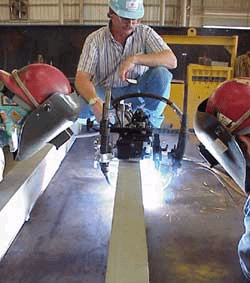
[a] the wire feed speed, [b] the weld voltage, [c] the weld speed.
Answer. [a]______________[b]______________[c]______________
[3] Provide an optimum, manual weld wire feed and volt setting for a
vertical up, 1/4 (6 mm), flux cored fillet weld on 1/4, carbon steel plate.
Wire 0.045 (1.2mm), E71T-1. Gas Ar - 25% CO2.
Answer WF______Volts__________
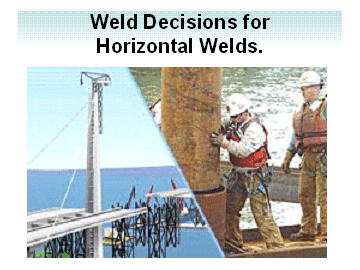
[4] Welding a 3/4 (18 mm) carbon steel or stainless plate, vessel, or on a pipe like below. The welders is going to weld the first Vee groove pass over the root. The groove welds will be made in the horizontal position. The wire used is an 0.045. E71T-1. Gas argon - 25% Co2.
[4a] Provide at least 3 important flux cored weld practices that will minimize the opportunity for lack of weld fusion – slag entrapment defects which are common to the first – second groove passes over the root.
[4b] Also provide for this horizontal weld, an optimum wire feed (WF) inch/min, voltage
WSO length, and gun angle.
[a] Answer The best weld practices are [1] __________________[2]________________[3]_______
[b] Answer. WF______Volts_______WSO _______ Gun Angle______________
 [5] The welder has set the correct E71T-1, flux core wire feed setting, and the result
has been a high
spatter weld and erratic globular transfer. Name two things
the welder should check before the weld becomes a mess.
Answer. [1]____________[2]_______________
[6] Why is the use of a gas shielded flux cored wire for an open pipe root weld
not recommended?
Answer.________________________________________________
[7] With groove welds, why should the welder be concerned with manual flux cored weld weaves that are wider than 8 mm?
Answer.________________________________________________
[8] If the welder has set the weld volts too high, what effects will the resulting excess arc length have on a vertical up E71T-1 fillet weld, and does the weld adjust the parameters so they know the arc length set is correct?
Answer.______________________[b]__________________________
[9] What are worm tracks and provide three reasons worm tracks occur in a 71T-1 weld
[9a] Why are worm tracks less common with the E70T-1 wires?
Answer. [9] Worm tracks are____________[1]__________[2]__________[3]___
Answer. [a]___________________________
[10] The welder is welding horizontal, stringer, cap welds. The steel weld joint is ¾ (18 mm), with a 50 degree, Vee groove included bevel. Should the welder use a slight fore hand or back hand for the stringer passes?
[10a] Using flux cored, what does a ceramic backed root have in common with
the flux cored cap pass data?
Answer. __________Why______________________
Answer [a]______________________ ___________
[11] With a ¾ (18 mm), horizontal Vee groove flux cored weld with ceramic backing should the welders use a fore hand (push), or back hand, (pul) technique, and why.
Answer: ____________________________________________
Why?________________________________________
[12] With manual welds on horizontal, groove fill passes, welding steels thicker than ½,
(>12 mm), in contrast to the common weld weaves, what benefits will be attained from stringer weld passes?
Answer. __________________Why____________________
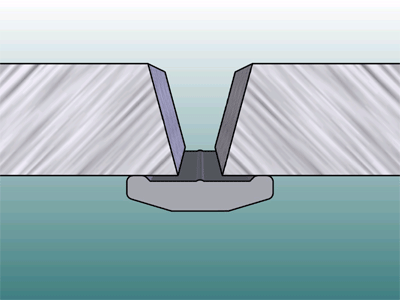 [13] Flux Cored groove welds in the flat position or horizontal
positions. Provide 3 important weld differences between welding
over a
steel backing, or over a ceramic backed groove weld?
Answer.[1]______________[2]_________________[3]____________
[14] As below, the welder is ready to weld an automated, vertical up, weld pass over the root weld on a ½ (12 mm) wall, 20 inch (50 cm) diameter pipe. Provide a wire feed, the weld travel rate and voltage start point for that 0.045 (1.2 mm) E71T-1 wire with 75 Ar – 25% C02.
Answer.WF____________inch/min. Travel ________inch/min. Volts____________
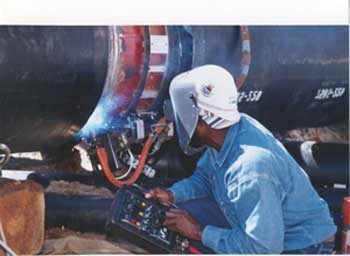
[15] The welder is ready to weld vertical up, single pass 8 mm fillet weld, on 3/8 steel plate, using an 0.052 (1.4mm) E71T-1 wire, and Ar - 25%CO2. The welder is using a digital wire feed control. Provide the wire feed rate in inch/min or m/min and the weld voltage
Answer. WF________________________Voltage______________________
[16] The weldder is about to weld the second "fill pass" in a 30 mm plate. This Vee groove weld is made in the flat position.
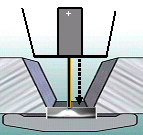
[a] Should the gun be at a push or pull angle, and why?
[b] To ensure optimum welds are being applied in the deep groove weld, before the welder strikes an arc in the groove, what should they do?
Answer. [a] .____________________Why__________________
Answer. [b] .____________________Why__________________
[17] Excess weld spatter with your flux cored welds could mean,
Answer Volts are too ____ or Amps are too _____
[18] Provide an optimum, single, wire feed and volt setting for fillet welds on steel plates that are 6 to 20 mm thick. Fillet weld position, vertical up. Wire 0.045 1.2mm E71T-1 wire. Gas 75 Ar - 25 CO2.
Answer WF___________Volts____________Why_____________________________
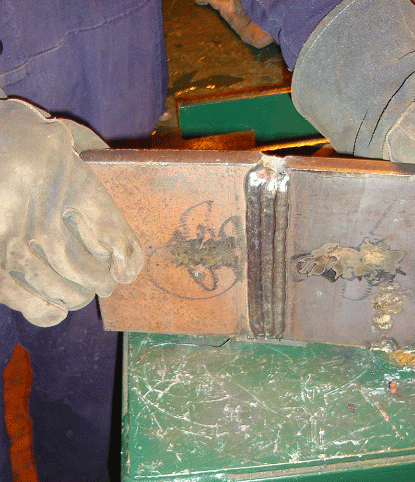
[19] Provide an optimum vertical up fillet weld, wire feed and voltage setting for an "0.052" (1.4 mm) E71T-1 wire, welding steel or stainless ¼ (7 mm) plates.
Answer._____________________Why___________________________
[20] Name three things you can do to minimize flux cored weld porosity.
[20A] How can you tell if the weld porosity is caused by insufficient weld gas flow?
[1]_____________[2]________[3]_____________
[a] _______________________________________
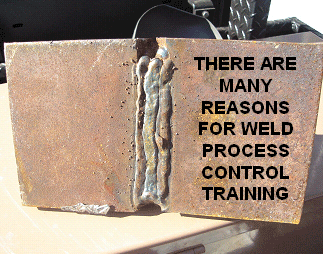
[20 b] What has caused the large pore flux cored weld porosity in the picture on the right 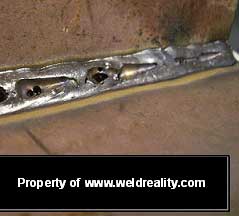
Answer. ___________________________________
[21] With the 0.045 (1.2 mm) wire and straight CO2 gas, most vertical up and overhead welds will be,
[a] 120 to 200 amps
[b] 150 to 200
[c] 200 to 230
[d] 250 to 300 amps
Answer__________________________________________
[22] Provide three things you can do to minimize slag entrapment in flux cored welds?
Answer. [1]_________________[2]_________________[3]__________
[23] You have to now set a mechanized carriage to weld using ah 1/16 (1.6mm), E70T-1 wire to weld a single pass, 5/16, horizontal fillet. Provide the WF, Volts and travel.
Answer. WF___________Volts_______________Travel________________
[24] You go for a job where they weld thick plate with large flux cored wires. You tell them you have a lot of experience with the flux cored process, They ask you to set the automated welds for a 1/2 fillet weld on 1/2 steel plate, (above photo). The welds are made in the flat position. With these carriage welds you are welding with an 3/32, (2.4 mm) E71T-1 wire. The gas is straight CO2. Provide the data for this common large plate application;
[a] The wire feed setting.
[b] The weld voltage.
[c] The weld Travel
Answers WF___________Volts_______________Travel______________
[25] You are welding mostly flat and horizontal ¼ - 5/16 single pass fillet welds with an 0.045 E71T-1 wire, and argon 25% CO2. The weld surface has "pock marks", explain why?
Answer.____________________ What would you change___________
[26] You see the flux cored wire tip is running into your weld, spatter is high. What is the first weld parameter you should adjust?
Answer.___________Why______
[27] In the picture below we have a ¼ (6 - 7 mm) flux cored fillet welds made in both the over head and vertical up positions. Provide a single WF weld setting that can be used with 0.045 E71T-1 wire with argon - 25%CO2?
Note: The weld voltage will have to be changed slightly for the over head weld, explain by approx.. how much, and why.
Answer WF ____Volts.___________Why?
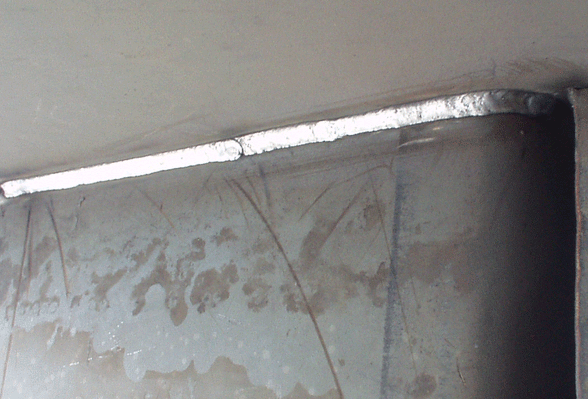
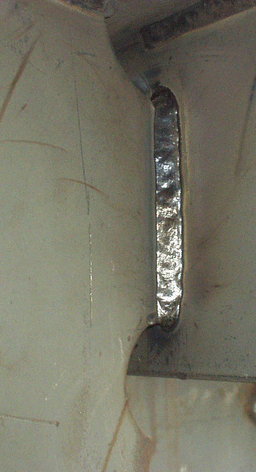
[28] With horizontal fillet welds, why should you limit the single pass weld size to 5/16.
[28a] What is the optimum size weld that should be used for multi-pass welds and why.
Answer__________________________
[a] ______________________________
[29] You want more energy in your E71T-1 welds to provide superior weld fusion. You could change that 80 argon - 20% CO2 shielding gas mix to two different gases, what and why?
Answer_______________Why does this work____________.
[30] The job is mostly vert up fillet welds made with an 0.045 wire set at 280 inch/min? The welders average 30 minutes arc on time each hour. How much weld wire will be required for each welder per 8 hr/day.
Answer_____________________________________
Do you think your weld personnel should be able to answer questions like above. With my unique flux cored or MIG process controls - best practice training programs, at www.weldreality.com, in a few hours, without the need to take notes. any weld personnel will have full control of the one of the world's most important weld processes and consumables.