The
MIG Welding Process Control Test.
From
Ed Craig. www.weldreality.com.
How important is MIG weld process
expertise to your career or organization?
[1]
You have a E70S-3, 0.035
- (1mm) MIG wire with argon - 20% CO2 gas. You have to set robot parameters for a lap
weld 0.080 (2 mm) gage parts. The lap weld has gaps approx. 0.060. (1.5 mm) What
wire feed setting, (or amps), volts and weld travel speed would you set?
Answer.
Wire feed___ Amps.____ Volts____ Weld Travel____ ipm
[2]
Manual MIG Weld a 1/16
(1.6 mm) sheet metal steel gage. Provide what you believe is optimum, "manual"
short circuit wire feed setting, weld current and voltage with an 0.045 (1.2mm)
wire and 80 argon - 20 CO2 gas.
Answer.
Wire feed___ Amps.____ Volts____
[3]
The robot weld requires s 220 amp spray transfer weld. The gas is an argon
- 10 CO2 mix and wire 0.035 (1mm).
[a]
In the robot pendant, what wire feed rate would you set?
[b] With
an arc on time of 30 minutes per/hr, how much weld wire will you use?
Answer.[a]_____________[b]________________
[4]
Which of the following is considered an optimum short circuit "weld
voltage range" for either an 035 or 045
(1 - 1.2 mm) wire?
[a]12 -
18 volts [b]17 - 24 volts [c]13 - 18 volts [d]16 - 20 volts
[5a]
Why is the back hand technique rarely recommended for welding thin gauge?
[b]
What is the best "weld position" to weld an 18 gage steel box?
Answer.[a]
______ [b]________
[6]
Which of the following is the manual welded recommended "thickness
range" when using an 0.035 (1mm) wire and the short circuit transfer?
[a]
26 gauge to 16 gauge, [b] 18 gauge to 12 gauge, [c] 14 gauge to 8 gauge.
[7]
Provide the robot weld data for [a -
c] for the following 1/8 (3 mm) steel parts. The parts are welded vertical down.
The butt weld parts have a 0.100 weld gap. Conventional CV. MIG power source. Wire 0.035.
(1mm). Gas Ar 75% - CO2 25%;
[a]
wire feed setting.
[b] volts.
[c] weld travel rate,
Answer.
Wire Feed Rate____ Volts____ Weld Travel Rate_____.
[8]
Why does a robot allow you to MIG weld thinner gage than a manual welder can weld?
[a]
What minimum steel thickness
can you manual weld with an 0.035 wire and the spray transfer mode?
[9a]
Which
MIG gas provides "dissociation" in the arc, influencing the weld penetration
and fusion profile?
[b] What is MIG gas dissociation?
oxygen, argon, helium, hydrogen, carbon dioxide.
Answer._______[b]___________________________________________________________
[10]
Your robot application can use a low spray transfer setting. What is the minimum
wire feed rate and weld voltage required with an 0.045 (1.2mm) wire to attain
a low spray transfer weld using an argon 10% CO2 gas mix.
Answer.
WF_____ inch/min. Volts_____
[11]
You are ready to robot weld a
3/16 (5mm) fillet weld. Using spray transfer and an 0.045 (1.2mm) carbon steel
wire, select the wire feed rate, voltage, weld deposition and robot weld travel
rate range most applicable.
Answer.
WF ___inch/min. Volts__ Deposition__ lb/hr. Weld Speed__ inch/min
[12]
To provide an optimum, "manual" 1/4 (6 mm) fillet weld, using spray
transfer and an 0.045 wire, provide an optimum wire feed setting, voltage and
weld travel rate.
Answer. Wire feed __inch/min. Voltage___ Travel Rate___
IPM
[13]
What robot wire feed rate, voltage, weld travel rate, position and welding gas
would you use to weld a 0.035
(1 mm) steel galvanealed, gage application with
an 0.035 MIG wire?
Answer.
Wire Feed___ Voltage___ Weld Travel Rate___ Part Position.
[14]
Robot Weld. Without changing the wire feed setting you increase the robot weld
travel rate. Which of the following would you typically have to adjust to compensate.
[a]
increase weld volts, [b] decrease weld volts.
Answer. ___________Explain why _________
[15]
When robot welding you have to
change the contact tip more than once a shift due to wire burn backs at the weld
start. For the weld and weld start data, you are using an 0.045 (1.2mm) wire set at
480 ipm with 30 weld volts. What changes would you make to the weld start data
to eliminate wire burn backs?
Answer.________________
Why will this data work?_________________
[16]
You are robot welding with an
0.045 wire and 80 argon 20 CO2. The weld and end data wire feed is 320 inch/min
with 24 volts, and globs are happening on the end of the wire cauasing weld start issues explain why
[17]
Which of these gas mixes will provide the most weld fusion and lowest weld porosity
when manual MIG welding carbon steels with an 0.045, E70S-3 wire in the spray mode and why?
[]
argon - 2 oxy [] argon - 5 oxy [] argon - 10 CO2
[] argon - 8 Co2 - 2 oxy
[] argon - 20 CO2.
Answer.
_________
[18]
Watching your robot weld, you note a globular, spatter producing weld transfer
with your 0.035 (1 mm) wire and 80 argon - 20%CO2, welding 4 mm steel parts. The
weld data is 180 amps at 24 volts, what adjustments to the robot weld parameters
do you make and why?
Answer. _____________Why___________?
[19]
You are welding with a mechanized carriage and you need to establish a multi-pass,
MIG weld procedure for a 60 degree, vee groove weld made in the flat position. The carbon steel plate is 25 mm. With the 0.045 (1.2mm) wire, provide the wire feed rate, voltage, travel
rate, and deposition rate for the hot pass.
Answer.
Wire Feed___
inch/min. Volts____ Travel Rate___ Deposition___
[20]
At the robot weld completion, you note a large weld drop attached on the wire
tip. What is the first thing you should adjust in the robot weld data to eliminate the weld drop on
the wire tip?
Answer _______Why_________?
[21]
You have to weld thin gauge (0.060), 300 series stainless with an 0.035, (1 mm)
309 MIG wire and the common three part helium tri mix, 90 He / 7.5 Ar / 2.5 CO2.
Why is this popular, global, helium tri gas mix the wrong gas choice? What should be the correct gas mix and why.
(hint Ed developed the gas mix)
Answer. The tri mix
is a poor choice because.__________________
and
the correct gas choice for the thin stainless is____________________
[22]
You are manually MIG welding pulsed or spray transfer on an aluminum application.
The aluminum parts are clean, however extensive black soot occurs either side
of the weld. What simple weld parameter adjustment will instantly decrease the
black soot. Why does this weld parameter adjustment work?
Answer. The
weld parameter adjustment is_______
Answer.
This parameter adjustment works because,_______
[23]
You are manually pulsed MIG welding a steel part. The part thickness and
weld needs an average weld current of 240 amps. Provide the pulsed peak current
and back ground current to attain 240 amps?
Answer. _________
[24]
With that robot or manual weld, what should be the maximum fillet weld size for
[a]
a horizontal fillet. Why_____?
[b]
a flat fillet. Why_____?
[25]
What is the minimum weld voltage when robot welding with spray transfer, using
either an 0.035 or 0.045 wire (1 - 1.2 mm) and argon 20% CO2?
[a] 22 volts
[b] 23 volts [c] 25 volts [d] 27 volts [e] 29 volts
[26]
Using an 0.052, (1.4 mm) steel MIG wire, what is the minimum part thickness
you can manually spray weld without weld burn through issues.
[b] What
is the minimum weld current required for spray with this 0.052 wire?
Answer.
[a]____[b]____amps
[27]
With an 0.045 (1.2 mm) wire and argon 20% CO2 gas, you are welding a 10 gauge
carbon steel part to a 3/16 (5 mm) part, The weld current is 240 amps with 24
volts. The parts are covered with spatter and the tips need changing every hour.
Why?
Answer.____________________________________
[28] Your pulsed
steel or stainless MIG weld is too narrow and convex, which pulsed parameter do
you change to make the weld wider?
[a] Why will this change give the results?
Answer
[a]_____[b]_____
[29]
Your pulsed steel or stainless MIG weld is erratic, the arc length is too
short and there is no more adjustment from the arc trim. Which of the following
pulsed parameters would you adjust and why?
Answer. Peak, Back Ground,
Wire Feed, Weld Amps, Frequency. Why?
[30]
Your manual pulsed steel or stainless MIG weld droplets are too large.
Which of the following pulsed parameters would you adjust and why?
Answer.
Peak. Back Ground. Wire Feed. Weld Amps. Pulsed frequency. Why_____
WITH
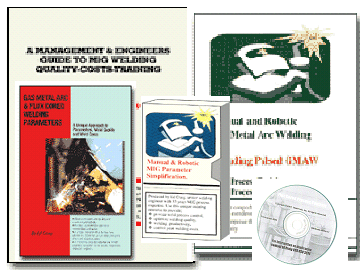
ED'S UNIQUE MIG AND FLUX CORED WELD PROCESS CONTROL TRAINING
AND EDUCATIONAL RESOURCES, PROCESS KNOWLEGE IS SIMPLIFIED AND ANYONE CAN HAVE THE ABILITY TO INSTANTLY PROVIDE
ANSWERS FOR THE ABOVE WELD QUESTIONS AND MANY MORE.
CALL
ED AT 828 337 2695 (EASTERN TIME USA)
or email ecraig@weldreality.com
IF YOU WANT MORE INFORMATION. Back
to all Ed's Programs at www.weldreality.com.
| |