| |
|
|
| |
|
|
| |
ED CRAIG. www.weldreality.com.
The world's largest website
on MIG - Flux Cored - TIG Welding
|

TIP TIG Welding is always better quality than TIG and 100 to 500%
faster with
superior quality than TIG - MIG - FCAW.
|
|
| |
|
|
|
|
written by Ed Craig www.welreality.com.
Welding
and steels info on ASTM - A36 TO A391.
Carbon Low Alloy Steels, Bar, Plate, Chain Tubes Pipe.
As changes are frequent, please ensure you refresh before reading.
ALL PROCESS - CONSUMABLES RECOMMENDATIONS MADE AT THIS SITE REQUIRE
WELD QUALIFICATION BEFORE
THE WELDS ARE APPROVED.
Note: When you see high tensile weld electrodes
required, this is usually an indication that pre heat, interpass and post
heat treatment is required for the welds.
IF YOU ARE
WELDING TUBES OR PIPES MAKE
SURE YOU VISIT THE ASTM
PIPE WELDING SECTION
 If
welding a carbon or low alloy steels and you don't know what the composition is
or what the weld consumable should be, give consideration to the following. If
welding a carbon or low alloy steels and you don't know what the composition is
or what the weld consumable should be, give consideration to the following.
-
If the metal is thicker than 1/4 - 6 mm, preheat to 150F.
-
Use either an E7018 stick electrode, an 0.035 or 0.045 E70S-3-6 MIG wire, or for
all position welds an E71T-1 electrode wire.
-
For MIG welding use an argon 10 to 20% CO2 mix.
- For
gas shielded flux cored use a gas mix with 20 to 25% CO2.
- Ensure
mill scale in weld area is removed and the plate is always at a temperature >60F.
- Keep
single pass fillet welds < 1/4 - < 6mm.
- Use stringer, do
not weave unless necessary.
- For
multi-pass welds. use inter-pass temp control. Ensure the inter-pass temp does
not exceed 300 F.
- If
possible do destructive test of a weld sample.
- If
possible have the hardness and grain size checked after welding.
- If
cracks occur in the HAZ double the pre-heat.
SMAW
and GMAW Mechanical Strength
E6010 Minimum Yield 50,000 psi Minimum
Tensile 62,000 psi.
E6011 Minimum Yield 50,000 psi Minimum Tensile 62,000
psi.
E7010 Minimum Yield 60,000 psi Minimum Tensile 72,000 psi.
E7018
Minimum Yield 60,000 psi Minimum Tensile 72,000 psi.
MIG E70S-3-6 Minimum
Yield 60,000 psi Minimum Tensile 72,000 psi.
When
welding low and medium carbon steels, the 70XX electrodes and E70S-3-6 MIG wires
and E7XT-X flux cored electrodes can be used. When welding low alloy 1 1/4
Cr 1/2 Mo and 2 1/4
Cr 1 Mo with up to 0.05% max carbon, typically 8018-B2L / 9018-B3L (L = low carbon)
can be used. When welding higher strength alloys or when tempering and quenching
are required to attain the higher strengths the higher carbon 8018 B2 and 9018
B3 electrodes are utilized.
The
"yield strength", the stress that
can be applied to a base metal or weld without permanent deformation of the metal.
The
"tensile strength", "the ultimate
tensile strength" is the maximum tensile strength that the metal or weld
can with stand before failure occurs.
Fine-grained
steels are prone to cold cracking due to hydrogen absorption. They should
be preheated slightly and welded with a relatively low specific energy, to reduce
the heat-affected zone. Preheating: in function of steel, generally 100°C
(max. 200°C) Post-weld treatment: usually not necessary
Austenitic
manganese steels with a manganese content of 14% (Hadfield steels) have
a tendency to form brittle precipitates in the form of carbides.
It is essential
to weld them without preheating, even with additional cooling, and to keep the
specific heat input low. Preheating: none (cooling may be used if needed
Unalloyed
steels
are prone to cold cracking. In many cases preheating is required to ensure good
weldability. Preheating: <
0.2C %: without preheating (up to 30 mm thickness) or 100°C against humidity
C: 0.2 to 0.5 %:preheating temperature 100 to 300°C
C > 0.5
%: preheating temperature 300 to 350°C.Possible
post-weld treatments, stress relieving, normalising
Low
alloy steels
are prone to cold cracking. In many cases preheating is required to lower hydrogen
potential and ensure good weldability.
| Mechanical
Strength of Gas Shielded Flux Cored Electrodes from the
ANSI/AWS A5.29. 1198
Specification
Low Alloy Steel Electrodes for Flux Cored Arc Welding |
| AWS
Classification | Tensile ksi |
Tensile
MPa | Yield ksi |
Yield
Mpa | | E6XTX-X-XM |
60 -
80 | 410
- 550 | 50 |
340 |
| E7XTX-X-XM |
70 -
90 | 480
- 620 | 58 |
400 |
| E8XTX-X-XM |
80 -
100 | 550
- 690 | 68 |
470 |
| E9XTX-X-XM |
90 -
110 | 620
- 760 | 78 |
540 |
| E10XTX-K9-K9M |
SEE
SPEC | |
88 |
610 |
| (M)
means an argon mix req, 75 to 80 argon balance CO2 |
All
DCEP | E71T-1
Second number
1 = all position |
E70T-1
Second number
0 = flat and horizontal |
|
 Brittleness:The
ease at which the weld or metal will break or crack without appreciable deformation.
The ease at which the weld
or metal will break or crack without appreciable deformation. The ease at which
the weld or metal will break or crack without appreciable deformation. When a
metal gets harder it becomes more brittle. Preheat, inter-pass temp controls and
post heat all are designed to reduce the potential for brittleness. Brittleness:The
ease at which the weld or metal will break or crack without appreciable deformation.
The ease at which the weld
or metal will break or crack without appreciable deformation. The ease at which
the weld or metal will break or crack without appreciable deformation. When a
metal gets harder it becomes more brittle. Preheat, inter-pass temp controls and
post heat all are designed to reduce the potential for brittleness.
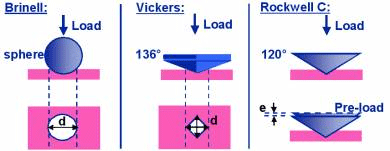
Hardness
test. The hardness tester forces a small sphere (Brinell, HB), a diamond
pyramid (Vickers, HV) or a cone (Rockwell C, HRC) into the surface of a metallic
material at a specific load. The resulting indentation is then measured.
 Irresespective of what the specifications stipulate, many
manufactures of parts and equipment containing ASTM steels do not use the recommended
pre or post-heat treatments, especially when multi-pass welds are required Irresespective of what the specifications stipulate, many
manufactures of parts and equipment containing ASTM steels do not use the recommended
pre or post-heat treatments, especially when multi-pass welds are required
The
requirements for weld heat treatment is greatly influenced by many factors, the
application, the governing specifications or codes, the plate condition, the plate
thickness, the weld consumables the weld procedures, the weld sizes and amount
of welds required.
In many cases the manufacturer that uses ASTM steels will find that it's not necessary
for the weld to match the mechanical properties of the steel, and will therefore
typically utilize low hydrogen, highly ductile E7018 /E70S-3-6 / E71T-1 electrodes.
When using the low hydrogen electrodes, the pre
and post heat treatment recommendations are frequently eliminated, however from
a weld quality perspective always ensure that the weld locations are dry, the
metal is over 60F, and that rust and mill scale is removed from the weld area.
Also even when heat treatment is not used its frequently beneficial to not allow
the multi-pass inter-pass weld temperatures to exceed 200F
If you ignore the heat treat requirements as recommended by the metal specifications
ensure you use low hydrogen electrodes then,
(a)
Establish the welding procedure.
(b) Qualify the weld and HAZ properties.
Ensure the after weld and HAZ properties are compatible with the steel specifications,
ref grain size, hardness and strength.
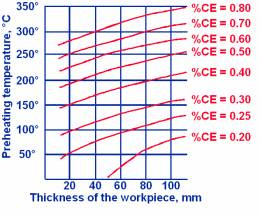
PRE HEAT IN THE FOLLOWING CHARTS ALSO APPLIES
TO MINIMUM INTER-PASS TEMPERATURE.
|
Alloy
steels always require weld consideration. Compare the
low alloy steels chemistry and mechanicals with a standard A36 steel. Remember
this is only a guide, weld responsibility starts with the weld decision maker
verifying the consumables and heat treat and test recommendations.
STRESS
RELIEVING (SR) BASIC GUIDELINES:
- STRESS RELIEF -
CONTROLLED HEATING & COOLING TO REDUCE STRESS.
- STRESS
RELIEF MACHINED PARTS FOR DIMENSIONAL STABILITY.
- STRESS
RELIEF SLOW HEATING AND COOLING REQUIRED
- CONFIRM
WITH CODE SPECIFICAIONS FOR STRESS RELIEF REQUIREMENTS.
| TYPICAL
STRESS RELIEF SOAK TIME
ONE HOUR PER INCH OF THICKNESS | SR
HEAT & COOL RATE PER HOUR 400oF 204oC DIVIDE THICKER PART |
PARTS
OF DIFFERENT THICKNESSES
SR MAX TEMP DIFFERENCE 75oF 24oC |
STRESS
RELIEF CARBON STEELS 1100oF 593oC
TO 1250oF 677oC |
STRESS RELIEF
CARBON 0.5% Mo
1100oF 593oC TO 1250oF 677oC |
SR
1% CHROME 0.5% Mo
1150oF 621oC TO 1325oF 718oC |
SR 1.25
% CHROME 0.5% Mo
1150oF 621oC TO 1325oF 718oC |
SR
2% CHROME 0.5% Mo
1150oF 621oC TO 1325oF 718oC |
SR 2.25
% CHROME 1% Mo
1200oF 649oC TO 1375oF 746oC |
SR
5% CHROME 0.5% Mo
1200oF 649oC TO 1375oF 746oC |
SR 7% CHROME
0.5% Mo
1300oF 704oC TO 1400oF 760oC |
SR
9% CHROME 1% Mo
1300oF 704oC TO 1400oF 760oC |
SR
12% CHROME 410 STEEL
1550oF 843oC TO 1600oF 871oC |
SR
16% CHROME 430 STEEL
1400oF 760oC TO 1500oF 815oC |
SR 9% NICKEL
1025oF 552oC TO 1085oF 585oC |
FOR
300 SERIES
STAINLESS SR WILL
RESULT IN CARBIDE PRECIPITATION |
WITH
LOW CARBON 300 SERIES
MAX SR 1050oF 566oC |
SR
400 SERIES CLAD STAINLESS
1100oF 593oC TO 1350oF 732oC |
SR
CLAD MONEL INCONEL Cu NICKEL
1150oF 621oC TO 1200oF 649oC |
STRESS
RELIEF MAGNESIUM AZ31B 0
500oF 260oC 15 MIN |
STRESS
RELIEF MAGNESIUM AZ31B
H24 300oF 149oC 60 MIN |
HK31A H24 550oF 288oC
30 MIN
HM21A T8-T81 700oF 371oC 30 MIN |
MAGNESIUM
WITH MORE THAN 1.5%
ALUMINUM STRESS RELIEF |
MAGNESIUM
CAST ALLOYS AM100A
500oF 260oC 60 MIN |
AZ-63A
81A 91C & 92A
500oF 260oC 60 MIN | |
Metric Conversion 1000 psi = ksi x 6.894 = MPa
| Steels | Yield
ksi
MPa | Tensile
ksi
MPa | Description | Preheat
Postheat | UNS |
Chemistry
weld data | | ASTM
A3 | | | carbon stl | | | mig
S3-S6 | | ASTM A27 | | | carbon
stl | | | mig S3-S6 |
ASTM
A36 | >36
>248 | 58
- 80
400/551 | Common
low carbon structural steel
CSA grades in compliance 260W 260WT 300W | <0.25carb
>25mm
100F. >50mm 200F
>0.26carb
13-25mm
50F. >25mm
175F | K02600 |
Carb
0.25/0.29
Mn 0.6/1.2
Si 0.15/0.4
E60XX
E70XX
E70S-X
E71T-1 |
ASTM
A 53
| | |
PIPE | | | WELD
MIG S3 - S6 | | A 82 | | | Reinforcement
wire | | | WELD
MIG S3 - S6 | ASTM
A105 | | |
High
temp fittings | |
|
E70XX
E70S-X
E71T-1 | ASTM
A108 | | |
Corresponds
to AISI specs | |
|
E60XX
E70XX
E70S-X
E71T-1 | | ASTM
109 | | | Carbon
stl strip | | | WELD
MIG S3 - S6 | ASTM
A113 | | |
Railway
stock | |
|
E60XX
E70XX
E70S-X
E71T-1 |
| A128 | | | Casting
Aust Mn | | | |
ASTM
A131
Grades
A-B-CS
D-DS-E
AH32-
DH32
EH32
AH36
DH36
EH36 | Grade
a/b/cs
d/ds/e
>34
Grade
ah32/
dh32
eh32
>46
Grade
ah36/
dh36
eh36
>51 | Grade
a/b/cs
d/ds/e
58 - 71
Grade
ah32/
dh32
eh32
>68
- 85
Grade
ah36/
dh36
eh36
>71- 90 |
Structural
steel for ships Canadian CSA G40.21
Grade A = 33G
Grade B = 33W | Preheat
CS/D/E >25mm 100F
Preheat ah/eh/dh
32-36 >13mm 50F >25mm 100F |
K02300 |
Carb
0.16/0.26
Mn0.7/1.5
Si0.1/0.5
AH/DH/EH
Ni0.4
Cr0.25
Mo0.8
Cu0.35
Grades a-e
E70XX
E70S-X
E71T-1
Grades ah/dh/eh
32-36
E8018-B2
E80T5-B2 |
ASTM
134 | | | Carbon
stl pipe | | | WELD MIG
S3 - S6 | | ASTM
135 | | | Carbon
stl pipe | | | WELD MIG
S3 - S6 | ASTM
139 | | | Carbon
stl pipe | | | WELD MIG
S3 - S6 | ASTM
A148
Grades 40/50/60
/80/85/90
95/105
120 | | |
Structural
castings | |
|
Grades
40/50/80
E8018-C3
Grades
60/90
E8018-B2
Grades
85/95/10/
120
E11018-M |
Many
steel types and their grades go back for 30 to 50 years. Today many grades are
obsolete. Its helpful to include these grades as many rebuilds and repairs deal
with the older grades. By the way if you don't see a chemistry range you are typically
seeing the maximum alloy content.
Fatigue:
The ability of a metal or weld to withstand repeated loads. Fatigue failures occur
at stress levels less than the metal or weld yield strength. Some things that
can influence fatigue failure:
- Excess
weld profiles.
- Welds
which cause undercut.
- FCAW
or SMAW slag inclusions.
- Lack
of weld penetration.
- Excess
weld heat, typically from multi-pass welds without inter-pass temp controls.
- Items
to a part that adds restraint while welding.
- Items
added to a part that can concentrate stresses in a specific location.
- Incorrect
selection of filler metal, weld too weak or weld too strong.
Steels
| Yield
ksi
MPa | Tensile
ksi
MPa | Description | Preheat
Postheat | UNS | Chemistry
weld data | ASTM
A161
|
| | Carbon
stl tubes |
| | WELD
MIG S3 - S6 |
ASTM
A167
|
| | AUSTENITIC
STAINLESS |
| | |
| A176 |
| | STAINLESS |
| | |
| A177 |
| | STAINLESS |
| | 308-308L |
| A178 |
| | Carbon
stl tubes |
| | 70S-3-6 |
| A179 |
| | Carbon
stl tubes |
| | 70s-3-6 |
ASTM
A181
Grades
1 - 2 | | | Forgings | Preheat
>25MM 100f
>50mm 200F | | Carb
0.35
Mn0.9
Si 0.35
Grade 1-2
E70XX
E70S-X
E71T-1 |
ASTM
A182
Grades F1/F2/
F11/F12
F22/F22A | | | High
Temp
fittings | Preheat
all grades except F1 at
>25mm 100F 50mm 200F
Grade F1
<13mm 100F <25mm 200F >25mm 300F
Post heat req 1250F | |
F2 Carb 0.21
Mn0.3/0.8
Si 0.1/0.6
Cu 0.5/0.8
Grade
F1
E70XX
E70S-X
E71T-1
GRADE F2
F11/F12
E8018-B2
grade
F22/F22A
E9018-B3
|
| ASTM 184 |
| | Reinforcement
bar |
carbon stl low alloy |
| E8018-G
- W
100 - 200F |
ASTM
185 |
| | Reinforcement
bar |
low alloy |
| E8018-G-W
100 - 200F |
ASTM
192
|
| | Tubes |
carbon
stl |
| E70S-3-6
100 - 200F
|
ASTM
193 |
| | Bolting |
| | 4
or 300 series
200 - 400F |
ASTM
199 |
| | Tubes |
Cr/Moly |
| 9018B3
300 - 400F |
ASTM
200 |
| | Tubes |
Cr/Moly |
| 200
- 600F |
ASTM
202 |
| | Pressure
vessel |
low alloy |
| 8018-G
9018-M
100 - 300F |
ASTM
A203
Grades a-b-d-e |
(A)
>37
255
(B)
>40
275
(D)
>37
206
(E)
>40
275 |
(A)
65-85
586
(B)
70-90
620
(D)
65-85
586
(E)
70-90
620 |
Pressure
vessel plates for cryogenic use. Nickel alloy steels |
grades
A-B-E
<13mm 200F
grades
A-B-E
<25mm 300F
>25mm
400F
grades
D
<13mm 100F
<25mm
200F
>25mm
300F
Post heat if carb >0.15 >13mm 1200F
Post heat if
carb <0.15 >25mm 1200F
|
(A)
K21703
(B)
K22103
(D)
K31718
(E)
K32018 |
(A)
Carb 0.17/0.23
Mn0.7/0.8
Si 0.15/0.4
Ni 2.1/2.5
(B)
Carb
0.21/0.25
Mn0.7/0.8
Si 0.15/0.4
Ni 2.1/2.5
(D)
Carb 0.17/0.20
Mn0.7/0.8
Si 0.15/0.4
Ni 3.25/3.75
(E)
Carb 0.2/0.23
Mn0.7/0.8
Si 0.15/0.4
Ni 3.25/3.75
Grades A-B
E8018-C1
E80T5-Ni2
E80S-Ni2
Grades D-E-F
E8018-C2
E80T5-Ni3
E80S-Ni3
|
ASTM
A204
Grades a-b-c | Grade
A
>37
255
grade B
>40
275
grade
C
>43
296 | Grade
A
65-85
448
grade
B
70-90
620
grade
C
75-95
655 | Nickel
Alloy Pressure vessel steels | Preheat
to 0.2 carb 25 to 50mm 100F >50mm 200F
Preheat
0.21-0.25 carb 13 to 25mm 100F >25mm 250F
Preheat 0.26-0.28
carb <13 100F >25mm 300F
postheat req 1250F | grade
A
K11820
grade B
K12020
grade C
K12320
| Grade
A
carb 0.25
Mn 0.9
Si 0.3
Ni 0.6
Mo 0.6
Grade B
carb 0.27
Mn 0.9
Si 0.3
Ni 0.6
Mo 0.6
Grade C
carb
0.28
Mn 0.9
Si 0.3
Mo 0.45/0.6
Grades A-B
E7018-A1
E70T5-A1
E8XT-A1
E70S-6 Grade
C
E8018-C2 | ASTM
209 |
| | Tubes |
| | E70S-3-6
50 - 200F |
ASTM
210
|
| | Tubes |
Carbon
stl |
| E70S-3-6 |
ASTM
211 |
| | Pipe
|
Carbon stl |
| E70S-3-6 |
ASTM
213 |
| | Tubes |
Chrome Moly and stainless pre-heat 200 - 600 F | | 8010
9018
308 |
ASTM
214 | | | Tubes | Carbon
stls | | E70S-3-6 |
ASTM
A216
WCA
WCB
WCC | | | High
tem cast fittings | | | WCA
E7018
E7XT-1
E70S-3
WCB-WCC
E7018
E7XT-1
E70S-3
E10018-M | ASTM
A217
WC1-WC4
WC5-WC6
WC9-WC11 | | | Steel
castings | post
heat req 1250F
preheat
WC1 <50mm 150F
>50mm 250F
preheat
WC4-WC5 <13mm 200F
>13mm 350F
preheat
WC9
500F preheat
WC6
WC11 <15% carb <25mm
150F >25mm 250F
>13mm 350F
preheat
WC6
WC11 to 21% carb <25mm
300F >25mm 400F
| | WC1
E7018
E7XT-1
E70S-3
WC4-WC5
E8018-B2
WC9
E9018-B3
WC6-WC11
E8018-B2
|
Lamellar
Tearing: When
welding, the weld shrinkage stresses impose tensile strains in the steel plate
or on inclusions paralleled to the plate surface. The tensile strains can separate
the inclusions causing cracks. Excessive strains can further elongate the cracks.
Carbon, manganese and low alloy steels made at the mill with inadequate deoxidization
are sensitive to lamellar tearing. The potential for lamellar tearing increases
with the amount of inclusions in the plates being welded. Of special concern is
when the inclusions are parallel to the plate surface. More data in ASTM A770
/ A770M Standard Spec for through thickness tension testing of steel plates.
 Weld
Question:
When you see an electrode recommendation such as E8018-C1, who is the best reference
source to convert that stick electrode to a flux cored or MIG wire? Weld
Question:
When you see an electrode recommendation such as E8018-C1, who is the best reference
source to convert that stick electrode to a flux cored or MIG wire?
Answer: I believe Alloy rods, (ESAB) Kobelco and Tri Mark,
flux cored manufacturers have good reference data for this subject.
| Steels | Yield
ksi
MPa | Tensile
ksi
MPa | Description | Preheat
Postheat | UNS | Chemistry
weld data | ASTM
A225
A-B-C-D | (C)
>70
482
(D)
<75mm
>60
(D)
>75mm
>55
|
(C)
105-135
930
(D)
<75mm
80-115
792
(D)
>75mm
75-100
689
| Pressure
vessel plate bar shapes Mn Vanadium Ni alloy steels | preheat
to 0.15 carb >50mm
100F
preheat
to 0.15/0.2 carb >50mm
100F >50mm 200F
preheat
>0.21 carb <13mm
100F >13mm
150F post heat
treat 1150F | grade
A K11803
grade B
K12003
grade C
K12524
| Grade
A
carb 0.18
Mn 1.45
Si 0.1-0.3
V 0.09/0.14
Grade B
carb 0.2
Mn 1.45
Si 0.1-0.3
V 0.09/0.14
Grade C
carb
0.25
Mn 1.6
Si 0.1-0.3
Ni 0.4/0.7
V 0.1/0.2
Grade D
carb 0.2
Mn 1.7
Si 0.1-0.5
Ni 0.4/0.7
V 0.18
grade A-B
8018-C3
E80S-Ni
E80T1-B2
grade C
E11018-M
E100S-1
E110T5-K3
grade D
E10018-M
E100S-1 | ASTM
226
|
| | Tubes
carbon stl |
| | E70S-3-6 |
ASTM
A234
WPA-WPB
WPC-WP1
WP11 |
| | Wrought
weld fittings |
| | grades
wpa-wpb
wpc
E7018
E7XT-1
E70S-3
grades wp1
E70XX-A1
E7XT-1
E70S-3
grades wp11
E8018-B2
|
ASTM
A235
A-C-C1
E-F-F1-G | | | Industrial
forgings | | | grades
A-C
E7018
E7XT-1
E70S-3
grades
C1-E-F-F1
E8018-C3
grades
G
E8018-B2 | ASTM
A236
A-B-C-D
E-F-G-H | | | Railroad
forgings | | | grades
A-B
E7018
E7XT-1
E70S-3
grades
C-D-E
E8018-C3
grades
F-G
E8018-B2
E8018-C3
grade H
E11018-M |
ASTM
A237
A-B-C-D
E-C1 | | | Industrial
forgings | | | grades
A-B
E8018-C3
grades
C-D
E8018-B2 grades
C1-E
E11018-M | ASTM
A238
A-B-C
D-E | | | Railroad
forgings | | | grades
A
E8018-C3
grades
B-C
E8018-B2 grades
C-D-E
E11018-M | ASTM
240
|
| |
Pressure Vessels stainless | | | austenitic |
ASTM
A242
1-2 |
42-50
344 |
63-70
482 |
High
stength low alloy structural steel to 100mm
In hot rolled state |
pre
heat
25-50mm
50F
>50mm 150F |
Type
1
K11510
Type 2
K12010 |
Canadian
CSA G40.21 50R Often call Cor-ten A
Type 1
Carb 0.15
Mn 1.0
Type 2
Carb 0.2
Mn 1.35
E7018
E7XT-1
E70S-3
Unpainted
weathering
steel
E8018-W
E80T1-W | ASTM
A243
A-C-C1
E-F-F1-G-
H-I-J-K |
| | Ring
and disc forgings |
| | Grades
A-C-C1
E70XX
E7XT-1
E70S-3
Grades
E-F-H-1
E8018-C3
Grades
F1-G-J-K
E8018-B2 |
ASTM
A245
|
| | Structural
sheets |
| | E60XX
E70XX
E7XT-1
E70S-3 |
Toughness:The
ability of the metal or weld sample at a predetermined temperature to withstand
a shock.
The test for
toughness measures the impact of a pendulum on a notched specimen. You may see
that the required impact properties for the metal or weld are 20ft-lbf @ -20 F
(27 j @ -29C)
Weld
Question:
Ed. Which should be the greater concern
rust or mill scale.
Answer: Mill scale causes much more weld
issues than rust.
Mill scale will effect
[1] the weld fusion potential,
[2] the weld travel rates attained,
[3] the weld appearance,
[4] the
weld mode,
[5] the arc stability,
[6] weld pororisity
[7] weld
spatter formation.
Ductility:
The amount that a metal or weld will deform without breaking. Ductility
is measured on welds by the % of elongation in 2 inch (51 mm) test piece. An E71T-1
flux cored electrode should result in a minimum of 20% elongation. An E70S-6 MIG
weld should produce 22% elongation.
| Steels | Yield
ksi
MPa | Tensile
ksi
MPa | Description | Preheat
Postheat | UNS | Chemistry
weld data | ASTM
249
|
|
|
Tubes stainless |
|
|
austenitic |
ASTM
250 |
|
|
Tubes C/Mo |
|
|
100
-200F
7018A1 |
ASTM
A252 |
| | AISI
specifications |
| | E70XX
E7XT-1
E70S-3
|
ASTM
A266
1-2-3 |
| |
Drum
forgings |
|
|
grades
1-2
E70XX
E7XT-1
E70S-3
grade 3
8018-C3 |
ASTM
268 |
|
|
Tubes stainless |
|
|
410
- 409
300 - 400F |
ASTM
269 |
|
|
Tubes
stainless |
|
| 300
series |
ASTM
270 |
|
|
Tubes
stainless
|
|
|
308 |
ASTM
271
|
|
|
Tubes stainless |
|
|
308 -316
- 347 |
ASTM
A276
Type 410 |
| | Stainless
see stainless |
|
|
|
ASTM
A283
A-B-C-D |
grade
A
>24
165
grade B
27
186
grade
C
3O
206
grade
D
>33
227
| grade
A
45-55
379
grade
B
50-60
4136
grade
C
55- 65
448
grade
D
60-72
496
|
Low
to intermediate
tensile steel plate. Canadian
G40.21 33G |
preheat
carb
0.25/0.3
>25mm
100F
preheat
carb
0.31/0.35
>13mm
100F
>25mm
200F |
| E70XX
E7XT-1
E70S-3-6 |
ASTM
A284
A-B-C-D |
grade
A
>25
172
grade B
>27
189
grade C
>30
206
grade D
>33
227
| grade
A
>50
344
grade B
>55
379
grade C
>60
413
grade
D
>60
413
| Low
to medium tensile carbon steel plates |
preheat
carb 0.2/0.25
>50mm
100F
preheat
carb 0.26/0.3
25/50mm
100F >50mm
200F
preheat
carb >0.3
>13mm
100F
>25mm
250F
If carb over 0.31 >25mm
post heat 1200F |
grade
A
K-1804
grade B
K02001
grade C
K02401
grade D
K02702 |
grade
A-B
carb 0.24
Mn 0.9
grade C
carb 0.36
Mn 0.9
grade D
carb 0.35
Mn 0.9
|
ASTM
A285
A-B-C |
grade
A
>24
165
grade B
>27
186
grade C
>30
206 |
Grade
A
45 - 65
448
grade
B
50 - 70
482
grade
C
50 - 75
517
| Low
to medium tensile pressure vessel plate to 50mm |
Preheat
carb >0.26
>25mm
100F | grade
A
K01700
grade B
K02200
grade C
K02801
| grade A carb 0.17
Mn
0.9
Cu 0.2/0.35
grade B
carb 0.22
Mn 0.9
Cu 0.2/0.35
grade C
carb 0.28
Mn 0.9
Cu 0.2/0.35
E70XX
E70S-6-3
E7XT-1
| ASTM
288
|
|
|
Forging carbon stl and low alloy stl |
|
|
7018
- 9018 - 11018. |
ASTM
289 |
|
|
Forging
alloy stl |
|
|
chrome mang |
ASTM
297 |
|
|
Castings |
|
|
308
-310- 330 |
ASTM
A299
A-B-C |
40-42
275-289 |
75-95
517-655 |
Carbon
Mn Si
Pressure vessel plates |
carb
to 0.2 preheat >25mm 150F
Carb
0.2/ 0.25 preheat >13/25mm
100F >25mm
150F
Carb
0.26/ 0.3 preheat <13mm
100F <25mm
200F >25mm 300F
Carb <0.2 to 13mm post heat not
req
Carb >0.2 post heat req 1150F | K02803 |
carb
0.28/0.3
Mn 0.9/1.15
Si 0.15/0.4
E70XX
E7XT-1
E70S-3-6
For
improved impacts
E8018-C3
E80T-1-Ni1 |
Weld
Question:
Ed. I have welded parts at Caterpillar plants. They weld many of the ASTM steels
listed here. They rarely use pre-heat even on the very thick steels. Why do they
not comply with the ASTM specs heat treat requirements?
Answer:
"A spec is only a spec"
No code or specification
body takes responsibility for what is written in their codes or specifications.
Specifications are set of guidelines. In the case of the ASTM specs the heat treat
recommendations are to make the weld properties conform with the base metal properties
yet many times its not practical or logical to do this. If an organization produces
multi-pass welds, the multi pass heat input act the same as a post heat treatment
and the extra passes will have an extensive influence on the mechanical properties
of the welds and the base metals.
Qualification of the multi-pass welds
and HAZ with the specific weld procedures utilized always will have far more relevance
than a specification which was typically written for a single pass weld.
| Steels | Yield
ksi
MPa | Tensile
ksi
MPa | Description | Preheat
Postheat | UNS | Chemistry
weld data | ASTM
A300
1-2 |
| | Low
temp pressure vessel |
| | grade
1
E70XX
E7XT-1
E70S-3-6
grade 2
E8018-C1
|
ASTM
A302
A-B |
| | pressure
vessel steel |
| | E8018-B2 |
ASTM
A306
45-50-55
60-65-70
75-80 |
| | Carbon
steel bars |
| | grades
45-50-55
60-65-70
E70XX
E7XT-1
E70S-3-6
grades
75-80
E8018-C1
|
ASTM
A311 |
| | corresponds
to AISI SAE steels 1137
Check out AISI weld and heat treat data |
| |
grades 1018-1117
E7018
E7XT-1
E70S-3-6
grades
1035-1045
1050
E10018-M
E100T1-K3
grades
1137 to 1144
E11O18-M
E110T5-K2
| ASTM
312 |
| | 300
series stainless pipe |
| | |
ASTM
A321 |
50-75
344-517 |
85-110
586-758 |
corresponds
to AISI SAE steels |
| | high
carb 0.55 max
Mn 0.6/0.9
Si 0.15/0.35
E9018-M
E90T1-K2
E80S-D2 |
ASTM
A328 |
| | steel
sheet pilings |
| | E7018
E7XT-1
E70S-3-6 |
ASTM
A322
|
| | corresponds
to AISI SAE steel bars
A322 over 70 AISI designations |
| | |
ASTM
A328 |
| | steel
sheet pilings |
carb
0.3 TO 0.4 >13mm 100F |
| carb
0.32/0.39
Mn 0.7/0.9
Cu 0.2 E7018
E7XT-1
E70S-3-6 | ASTM
A331 |
| | corresponds
to AISI SAE steel bars
A322 over 80 AISI designations |
| | |
ASTM
A333
A334 |
| | carbon
steel and low alloy pipe |
| | E8018 |
Hardness.
The
resistance of the metal or the weld to penetration.
The resistance of the metal or the weld to penetration. Hardness is related to
the strength of the metal. A good way to test a weld after the weld and heat treatment
are complete is to test the hardness of weld and the base metal surrounding the
weld.
| Steels | Yield
ksi
MPa | Tensile
ksi
MPa | Description | Preheat
Postheat | UNS | Chemistry
weld data | ASTM
A335 | | | Cr
Mo Pipe | | | | ASTM
A336
F1-F12 | | | Alloy
drum forgings | | | grade
F1
E7018
E7XT-1
E70S-3-6
grade F12
E8018-B2 |
ASTM
A350
LF1-LF12 | | | | LF1
- LF2
preheat <25mm 100F >25mm 200F
LF3 - LF5
preheat <25mm
100F >25mm 200F | | E8018-C1
E8018-C3
E80T1-Ni1 | ASTM
351
| | | Stainless
castings | | | 308
310
316 | ASTM
A352
LCA-LCB
LCC-LC1
LC2 | | | low
temp steel castings | preheat
grades
LCA-LCB-
LCC
<0.25 carb >25mm 50F >50mm 100F
preheat LCB
0.26/0.3 carb <25mm 50F >25mm 100F
preheat LC1
<25mm 100F >50mm 300F
preheat LC2-3-4
carb max 0.15
<25mm
100F >25mm 250F
preheat LC2-3-4
carb max 0.25
<13mm 150F
>13mm 250F >25mm 325F | | Grades
LCA-LCB
E7018
E7XT-1
E70S-3-6
Grades LC1
E7018-A1
Grades LC2-3
E8018-C1
E8XT1-Ni2
Post heat
desirable
1150F | ASTM
A353 | >75
517 | 100-120
689-827 | 9% Nickel pressure
vessel steel plate | preheat
<25mm 50F >25mm 150F | K81340 | Carb
0.13
Mn 0.9
Si 0.15/0.4
Ni 8.5/9.5
ENiCrFe-3
INCO 182
ENiCrFe-2
INCO-A
ERNiCr-3
INCO 82
or ERNiCrFe-6
INCO
92
E309/E310
often used | ASTM
A356
1-2-5-6-
9-10 | | | Steam
turbine castings | | | grade
1
E7018
E7XT-1
E70S-3-6
grade 2
E7018-A1
E8018-C3
grade 5
E8018-B2
E90T1-D3
grade 6-9-10
E8018-B2
E80T1-B2 | A358
| | | Austenitic
Stainless pipe | | | | ASTM
A361
| | | Galvanized
sheet | | | E60XX
E70XX
E70S-3 |
Weld
Questions. Do you have the instant answers? What do you think the optimum wire feed and weld voltage range is for welding
with an E70T-1 1/16 062 flux cored wire welding a common 6 mm - 1/4 fillet weld. The answers
are in my books.
| Steels | Yield
ksi
MPa | Tensile
ksi
MPa | Description | Preheat
Postheat | UNS | Chemistry
weld data | ASTM
A366 |
| | Carbon
steel
sheets |
| | E60XX
E70XX
E70S/3-6 |
ASTM
369 |
| | Carbon
stl and Cr Mo Pipe |
| | see pipe |
ASTM
A372
1-2-3-4 |
| | Pressure
vessel forgings |
| | Grade
1
E7018
E70S-3-6
E7XT-1
grade 2
E8018-C3
grade
3
E8018-B2
grade 4
E11018-M
|
ASTM
A374
A375
|
| | Low
alloy steel strip |
| | E7018
E70S-3/6
E7XT-1
|
ASTM
376 |
| | Austenitic
Stainless pipe |
| | see pipe |
ASTM
381 |
| | carbon stl pipe |
| | 7018
E70S-6 |
ASTM
A387
2-5-7-9
11-12-21
21-22
|
grade
2
>33 Annealed
grade 2
>45
normalized |
grade 2
55-80 Annealed
grade 2
70 - 90
normalized
| pressure
vessel plate
Cr Mo available in annealed normalized state |
grade
2
PREHEAT to O 0.15 carb <25mm 200F
grade 2
PREHEAT > O
0.16 carb <25mm 300F >25mm 400F
grade 2 post heat 1200F |
grade
2
K121143
grade 5
K415445
grade 7
S50300
grade 9
S50400
grade 11
K11789
grade 12
K11757
grade 21
K31545
grade 22
K21590 |
grade
2
carb 0.2
Mn 0.55/0.8
Si 0.4
Cr 0.5/0.8
Mo 0.45/0.6
grade 2-12
E8018-B2
E80T1-B2
grade 21-22
E9018-b3
E90t1-b3 |
ASTM
A389
C23 | | high
tem castings
| | | | E8018-B2 |
A391
Grade 80 | | Alloy | higher
strength than A413 chains can be used for overhead lifts | | | |
| Ed
in Thailand managing a Textron project.
The mission fix a 276,000 psi tensile
steel
armor plate,mult-million dollar
welding problem: |
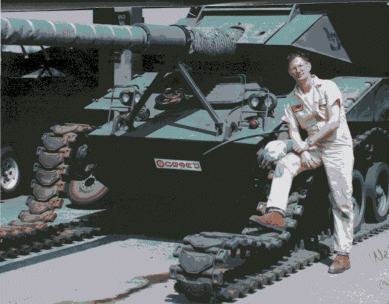
This
USA Textron tank was made out of 275.000 ksi tensile, armor
steel. Due
to lack of weld manufacturing management, some parts
were welded in the wrong location between the tank tracks. These
welded parts were subject to abnormal stresses from the tracks and resulted in
numerous cracks when the tanks were field tested in Thailand.
If you
tried to repair the armor plate cracked welds which had extensive martensitic formation in
their HAZ, more cracks would instantly occur from the weld repair heat input.
What would you recommend to resolve this multi-million dollar issue. This was
my first consulting job and it was a real welding challenge.
If
you are teaching your self, or providing weld process control training for others,
the following resources are the key to attaining MIG and flux cored weld process
optimization.
Item.1.
The Book: "A Management & Engineers Guide To MIG
Weld
Quality, Productivity & Costs"
Item
2. A unique robot
MIG training or self teaching resource.
"Optimum
Robot MIG Welds from Weld Process Controls".
Item
3. A
unique MIG training or self teaching resource.
"
Manual MIG Weld Process Optimization from Weld
Process Controls".
Item.
4.
A unique flux cored training or self teaching resource.
"Optimum Manual and Automated Flux Cored Plate and
Pipe welds.
Item
5a."Proceso
de Soldadura MIG Manual"
(MIG Made Simple. Self teaching in Spanish)
Item
6a. The
Self Teaching MIG Book/ Video. (MIG
Made Simple in English).
Note:
Items 2-3-4 are the most comprehensive process control,
self teaching and training programs ever developed..
Visit
Ed's MIG / flux cored process control books and CD training
resources.
|
Return
to www.weldreality.com home page.
| |
| |
| | |