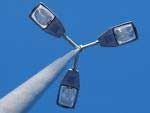
One customer I assisted around 2005, manufactured carbon steel
street lamps 11 to 7 gage. It’s a simple manual welding application. On the
end of the lamps they weld a flange that mounts the lamp to the floor. The flanges
were heavy duty approx. 13 mm thick. They also weld around an access box, (gage
material) located on the post surface near the flange.
 This
street lamp application became unnecessarily complex the day they decided the
parts should be welded with a robot. The company ordered a Fanuc ArcMate 100 robot.
The robot came with the Lincoln Power Wave, a 450-amp, pulsed MIG power source.The robot system was
sold by AGA who had the technical support of Lincoln / Fanuc. Almost two years
after the robot was installed the robot had never come close to it’s daily
weld production quota.
This
street lamp application became unnecessarily complex the day they decided the
parts should be welded with a robot. The company ordered a Fanuc ArcMate 100 robot.
The robot came with the Lincoln Power Wave, a 450-amp, pulsed MIG power source.The robot system was
sold by AGA who had the technical support of Lincoln / Fanuc. Almost two years
after the robot was installed the robot had never come close to it’s daily
weld production quota.
When the robot was installed it was placed on
the lamp production line, however numerous weld issues occurred and the management
moved the robot to another part of the plant. The robot was moved to a location
where the highly trained plant personnel could “play around” with the
settings. With the assistance of Lincoln, Fanuc and AGA, they played around
for almost two years to no avail.
The robot lamp welding issues generated daily were numerous and the plant
management viewed the robot as a liability, not capable of meeting the simple
weld production goals. In the 24-month playing around period, AGA, Fanuc and Lincoln
personnel made numerous visits to the plant without any success.
EXCESSIVE ROBOTIC GUN TOUCH SENSING.
To locate the two basic welded
parts, the robot first used it's touch sense feature. The robot was programmed
to use 28 touch points for one simple square flange and one rectangle part. The
touch sensing took 50 seconds or approx. 20% of the 4 minutes 10 seconds robot
cycle time. The amount of touch-sensing used was beyond excessive was an indication
of the lack of expertise that had been used on this applcation.
SELECT
THE WRONG WIRE SIZE AND THE WELDING PROBLEMS BEGIN.
Two years previously, when the first robot welds were made, someone recommended
the pulsed MIG process, using an 0.045 (1.2mm) wire. The resulting pulsed welds
from the PowerWave were too hot for the application. Someone on the Lincoln /
Fanuc / AGA team, for some strange reason recommended an 045,
E71T-1, all
position, gas shielded, flux cored wire.
I was requested
to come to the plant to see if I could spread some "light on the subject".
In a few hours I came to the conclusion that in the attempt to resolve the robot
“weld process issues” too much focus was placed on the utilization of
the robot's bells and whistles rather than on optimizing the parts and weld process.
The following
daily weld issues occurred with the flux cored process, keep in mind the weld
and production issues had nothing to do with the weld process used.
[a]
Inconsistent weld results, requiring constant robot program changes.
[b]
excessive weld burn through every shift,
[c] lack of weld fusion on the majority
of parts,
[d] excessive undercut,
[e] slag entrapment.
THE
WELD CHANGES AND $AVINGS BEGIN.
Variable weld gaps were an issue which were partially addressed by the robot touch
sensing. The gaps were generated by the assemblers of the lamps. When these guys
tacked the parts they did not evenly distribute the gaps. So I took on the role
of the supervisor and provided instructions and gages to the assemblers that the
gaps presented to the robot had to be 0.060 (1.6mm), which was acceptable for
this application.
The next thing I checked was the reliability of the Fanuc
robot touch sensing equipment. It worked fine. We reprogrammed the robot to touch
the parts only six times instead of the 28 times used previously. I tested the
repeatability, it was OK. The touch time cycle per part was reduced from 50
seconds to 10 seconds.
WELD PROCESS AND CONSUMABLE
LOGIC
Any one who has read my Robotic MIG Welding
books would be aware of the fundamental fact that with traditional MIG, the
most superior wire size for parts less than 3/16 (4.8 mm) is an 0.035 or 0.040
wire. Especially when the parts have weld gaps. I replaced the 0.045 (1.2mm) flux
cored wire with an 0.035 (1mm) MIG E70S-3 wireand used an argon 10% CO2. I welded
the parts first using a combination of short circuit and spray transfer. I then
set the Power Wave to produce pulse welds on the parts. All the welds produced
were optimum from a quality and deposition rate perspective. Proponents of the
costly pulsed process note. The differences between the pulsed and traditional
short circuit and spray mode welds were not measurable.
MAKE SIMPLE ROBOT MOVES.
For the robot to weld all the way around the square end flange weld joint, which
by the way was in a fixed position. The robot made two welds, one each side, each
move wrapping halfway around the square joint. The robot moves were complex, stretching
all 6 axis of the robot to it's limits. In stretching the robot reach limits,
many of the welds did not have the weld gun positioned for optimum weld control.
From a programmer perspective, when robot program points become complex, they
eventually will require correction. In these circumstances the robot operator
may find it difficult to duplicate the initial program moves.I
had the flange reprogrammed and produced four simple straight welds with optimum
gun angles.
AFTER 3 DAYS AT THE PLANT,
THE PAY OFF. With
the new robot program in place, the 0.035 MIG wire and the new weld procedures,
I reduced the lamp total cycle time by 50%. We welded 20 lamps and did
not have an issue with a single weld. The bottom line, the customer now had a
stable process and could now produce in two shifts what they were going to produce
in three shifts.
CONCLUSION:
 This
application took place in early days of the Lincoln PowerWave.
When the 0.045 MIG wire was recommended the optimum pulsed weld parameters delivered
by the Power Wave, even after lap top program changes were made, were simply too
high for the gage parts and weld gaps.
This
application took place in early days of the Lincoln PowerWave.
When the 0.045 MIG wire was recommended the optimum pulsed weld parameters delivered
by the Power Wave, even after lap top program changes were made, were simply too
high for the gage parts and weld gaps.
IN MY BOOKS AND CD TRAINING PROGRAM, PART OF THE RECOMMENDED ROBOTIC
WELDING PROCESS CONTROL PROGRAM, IS EVALUATE THE SIZE OF THE WIRE AND THE
SUITABILITY OF THE WELD CURRENT USED ON THE APPLICATION
Recommending
a “deep penetrating” 0.045 all position flux cored wire for the pulsed
power source made little sense, have you ever tried this flux core wire to weld
an open root. (Fanuc had no clue, Lincoln and AGA should have known better). Also
some of the flux-cored welds were made in the “vertical down” position,
this wire is not designed for this, as slag entrapment always occurs. For the
flux cored wire to function on the thin gage post, low weld setting had to be
used. The low flux cored welding parameters, and vertical down weld positions
ensured not only slag entrapment but lack of fusion for the thicker flange side
of the weld.
In
contrast to the 0.045 wires, the 0.035 MIG wire was the key due to its current
range compatibility with the application. This part did not require the pulsed
transfer mode, however as the company had spent thousands more than it needed
to with the purchase of the PowerWave, I left the settings in the pulsed mode.
I charged them approx. $3000 For the elimination of the weld problems, weld rework
and 50% increase in production. I don't recall getting a Hall Mark thank you card
from Lincoln, AGA or Fanuc.
Ed Craig www.weldreality.com:
Back to Ed Craigs Welding Projects