Pulsed
MIG welding Torque Converters:
THE
LINCOLN POWER WAVE, WAS NOT
UP TO THIS SIMPLE WELD CHALLENGE.
 It's
only fitting that my last weld consulting job in the year 2000, that I ended up
would be working a General Motors plant and using the infamous Lincoln pulsed
MIG equipment. The GM management were not satisfied with their new multi-million
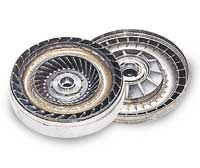
dollar weld production line. This line had been set up to automatically weld torque
converters up to a 1000 units a day.
It's
only fitting that my last weld consulting job in the year 2000, that I ended up
would be working a General Motors plant and using the infamous Lincoln pulsed
MIG equipment. The GM management were not satisfied with their new multi-million
dollar weld production line. This line had been set up to automatically weld torque
converters up to a 1000 units a day.
The
torque convertors parts are delivered to the weld stations by conveyors. The round
parts then rotate with the MIG welding guns stationary. The parts required 3/16
(4.8 mm) horizontal lap welds.
Each
weld station had three MIG guns which would simultaneously weld the converters
as they rotated. The pulsed MIG weld problems generated generated from the Lincoln
equipment were;
[a]
An 8% leak rate from the multi MIG pulsed welds. In the auto industry this leak
rate in some plants would be considered good, however at this GM plant, the production
volume was extensive, the finished machined torque converters costly and weld
repairs were not allowed.
[b]
Excess weld heat from the multi-torch operation was causing production "assembly"
issues.
The
Lincoln power source pulsed arc weld instability at the recommended pulsed wire
feed settings established by Lincoln, caused extensive weld quality issues, rework
and productivity issues for GM. The engineers had worked out the annual weld rework
and loss of productivity losses for this plant would be in the range of 1.5 to
2 million dollars.
The
pulsed MIG welding issues from the brand new welding lines were;
[1]
welds skipping resulting in weld areas that contain thinner, partial welds, weld
globs or missed welds requiring weld repairs,
[2] welds with inconsistent
weld penetration, causing rejects from the leak tests,
[3] excess weld
porosity,
[4] Inconsistent weld surface appearance,
[5] weld
undercut,
[6] extensive, pulsed arc starts, craters and weld tie-in issues,
[7] too many wire burn back to contact tip issues,
[8] extensive
pulsed weld equipment break downs.
The Lincoln Power Wave
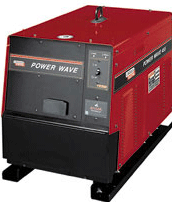 After analyzing
the issues for two days, I came to the conclusion the primary issues were a result
of the Lincoln Power Wave and the inconsistent pulsed weld transfer mode. On the
third day I changed the wire diameter utilized and switched the pulsed mode off.
I set up optimum spray transfer parameters and established techniques that would
allow higher weld speeds for the rotating converters parts. The reject figures
were reduced to "0%" and the weld heat problem was eliminated with my
higher weld speeds. The higher weld speeds provided 27% more production than the
line was deigned for.
After analyzing
the issues for two days, I came to the conclusion the primary issues were a result
of the Lincoln Power Wave and the inconsistent pulsed weld transfer mode. On the
third day I changed the wire diameter utilized and switched the pulsed mode off.
I set up optimum spray transfer parameters and established techniques that would
allow higher weld speeds for the rotating converters parts. The reject figures
were reduced to "0%" and the weld heat problem was eliminated with my
higher weld speeds. The higher weld speeds provided 27% more production than the
line was deigned for.
Reliability
- Reliability - Reliability: What I found interesting about this costly, high
volume installation, was the two production lines used three guns in each weld
cell requiring six Lincoln Power Wave, pulsed MIG power sources. The lines were
not yet in the production mode, yet the plant engineers informed me that four
of the six pulsed power sources had already been replaced.
The
bottom line the weld application was welded with traditional spray transfer which
was found to be more stable with the high weld speeds than the pulsed mode. If
the lower cost, traditional, more durable Lincoln CV 400 power sources had been
purchased for this line, I know several GM engineers that today would have more
respect for the red welding equipment.
From my point of view. On this multi-million
dollar production line, I saved GM at least two million dollars annualy and I
gave GM an invoice for five thousand dollars for a zero reject weld program and
twenty seven percent increase in production, yet not a one single manager in the
plant indicated any interest. I guess the subject of welding was something they
did not get too exited about, or if they wanted to know about welding they figured
they could always call Lincoln.
2000.
Ed Craig.
 It's
April 2005. Bob Lutz the Vice Chairman of GM finally speaks out on the expertise
of some of his engineers.
During a speech to the at the Society of Automotive Engineers, GM Vice Chairman
Bob Lutz states, that US. auto manufacturers could streamline there design process
if American design engineers were trained more like their Asian or European counterparts.
Bob continues, "we are actually training our North American engineers to
be "managers" while the rest of the world trains them to be doers".
It's
April 2005. Bob Lutz the Vice Chairman of GM finally speaks out on the expertise
of some of his engineers.
During a speech to the at the Society of Automotive Engineers, GM Vice Chairman
Bob Lutz states, that US. auto manufacturers could streamline there design process
if American design engineers were trained more like their Asian or European counterparts.
Bob continues, "we are actually training our North American engineers to
be "managers" while the rest of the world trains them to be doers".
From
Ed: I wonder if the chairman of GM recognizes the root cause and much greater
cost consequences of a more serious engineering qualification issue?
THE
LACK OF PROCESS CONTROL EXPERTISE OF ENGINEERS AND MANAGERS IN THE LAST TWO DECADES
HAS HAD A TREMENDOUS IMPACT ON THE PROFITABILITY OF MANY HIGH VOLUME PART MANUFACTURERS
FROM JOHN DEERE TO GENERAL MOTORS. GM FORD AND CHRYSLER HAVE BEEN LEADERS IN "HANDS
OFF MANAGEMENT AND LACK OF MANAGEMENT / ENGINEERING PROCESS OWNERSHIP" AND
OVER THE LAST DECADE THESE COMPANIES PAID AN EXTENSIVE PRICE FOR THEIR MANAGEMENT
PROCESS APATHY.
The Lincoln Power Wave and Axle Cracks
Back to Ed Craigs Welding Projects