Home
page of weldreality.com.
Pulsed
MIG Lincoln
Power
Wave and Axle Cracks:
If
you want to make your weld manufacturing life more expensive, more complex and
less meaningful than it needs to be, you could always have listened to a salesman
and purchased the Pulsed Lincoln
Power Wave
for your robot application.
1999
-2000: My weld task appeared simple. A tier one, axle manufacturer
located in Michigan ordered two robot systems to weld truck axles. The company
I worked for supplied the robots, we were also responsible for setting up the
robot cells that would provide one million axles annually.
When the robot cells were complete, as part of the contract, we were required
to provide a few hundred welded axles as part of the robot cell run off, (these
guys were hell bent on getting a robot system that worked before being delivered).
The axle manufacture had previously utilized the traditional
Lincoln CV 400 and 600 amp units. The CV equipment used spray transfer for decades
and there had never been any serious weld quality or productivity issues, however
we all know there is always someone waiting in the wings ready to spoil things.
An inexperienced corporate weld engineer at the axle manufacturer selected the
pulsed mode and decided on the Lincoln pulsed Power Wave weld equipment. The carbon
steel, MIG wire size selected by the axle manufacturer was
0.052 (1.4mm).
Two factors were critical for
the axle project:
[1] The axle
fillet weld sizes must never be smaller than a 1/4 (6mm).
[2] As the
annual axle production was a million plus units, every second saved on the weld
cycle times was considered critical to the bottom line.
TRADITIONAL
WELDING METHOD: The
axle manufacture had produced axles for decades with the regular MIG CV equipment.
The axles were welded with an 0.052 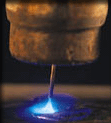 (1.4mm)
MIG wire and an argon CO2 mix. The CV equipment used spray transfer to weld the
1/4 (6mm) fillet welds at typical robot weld travel speeds of 20
to 22 in./min. (1.4mm)
MIG wire and an argon CO2 mix. The CV equipment used spray transfer to weld the
1/4 (6mm) fillet welds at typical robot weld travel speeds of 20
to 22 in./min.
My first objective with the Lincoln PowerWave and
pulsed mode and the 0.052 wire, was to to attain the same travel (production)
rates as that previously attained. When setting the Lincoln pulsed PowerWave weld
data, to attain the desired weld speeds, I had to set the 0.052 (1.4mm) pulsed
wire feed rate 400 - 450 in./min. This wire feed
rate is considered the controlled high end of traditional spray transfer for an
0.052 wire and was used successfully for years with the conventional CV equipment.
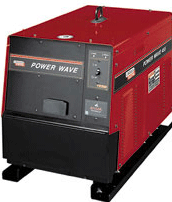
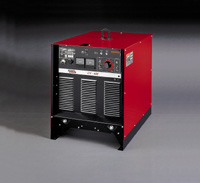 USA, CV weld equipment like this sells for $2000 to $4000, it was very successful on axle welds and had
hardly changed in more than four decades. USA, CV weld equipment like this sells for $2000 to $4000, it was very successful on axle welds and had
hardly changed in more than four decades.
 The
Lincoln Power Wave Dilemma: The
Lincoln Power Wave Dilemma:
It was evident
when I was setting the Power Wave, that the pulsed equipment did not respond well
to the 0.052 wire and the common 420 in./min wire feed settings. The resulting
high energy, pulsed arc plasma was both "narrow and intense" resulting
in a weld arc plasma that caused a "deep
penetrating (digging) effect" on the axle welds.
 The
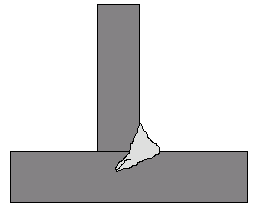
first big news that came from the high Power Wave pulsed settings, was with the
robot weld travel rate attained. At the desired minimum robot weld speed of 22
ipm, I ended up with an external fillet weld profile that measured only 3/16 (4.8mm). The
first big news that came from the high Power Wave pulsed settings, was with the
robot weld travel rate attained. At the desired minimum robot weld speed of 22
ipm, I ended up with an external fillet weld profile that measured only 3/16 (4.8mm).
When the 3/16 fillet weld was cut and a macro evaluation of the internal
weld profile provided, it revealed that the intense, narrow pulsed plasma had
caused the root part of the weld to penetrate almost threes times greater than
traditional MIG spray penetration.
To get the deep penetrating,
fillet weld to an acceptable 1/4 (6mm) fillet weld size, (the weld was measured
by its surface dimensions) the robot, pulsed weld travel rate would have to be
reduced to a travel rate of 15
- 17 in./min. This 25% reduction
in weld travel rate would have a huge impact on the axle weld cycle time, remember
every second lost was multiplied by a million axles. I went through all the possible
external Power Wave pulsed parameter adjustments, however I could not change the
intensity or the narrow profile of the pulsed MIG weld plasma at the 400 - 420
ipm wire feed rates we had to use. I reluctantly contacted Lincoln. The reason
I was reluctant was simple, a life time of dealing with Lincoln had provided me
with thick skin and an attitude of minimal expectations.
 Lincoln
with it's reputation on the line "again",
flew in one of its brighter, graduate weld engineers. The engineer arrived cell
phone to ear and laptop in tow. I demonstrated with the robot how at the required
0.052 wire feed rate, the resulting pulsed plasma was "too narrow and too
intense" for the thick axle application. Lincoln
with it's reputation on the line "again",
flew in one of its brighter, graduate weld engineers. The engineer arrived cell
phone to ear and laptop in tow. I demonstrated with the robot how at the required
0.052 wire feed rate, the resulting pulsed plasma was "too narrow and too
intense" for the thick axle application.
The Lincoln young engineer
who looked like he just graduated high school, smiled and told me not to worry,
as one of the prime features of the PowerWave was that with the assistance of
their unique lap top software, he could change the power source wave forms to
suit any application. I smiled back at him, and said "good
luck".
To
perform the test welds, I provided the Lincoln engineer with a long piece of 3/8
(9 mm) carbon steel plate with a ground surface and told the Lincoln engineer
that when his power source could place a robot butt weld on the surface of this
3/8 plate with the 0.052 wire without providing an unacceptable digging crater
effect, then his work was done. Two days later, his over worked lap top had provided
every possible combination of pulsed parameters and wave forms. With the 0.052
wire feed rate set at 420 ipm, the high energy, digging pulsed arc plasma still
remained narrow and too intense for the axle application.
The
red faced Lincoln rep who had stopped smiling the day before, packed up his computer
and left, promising that "his people"
would look into the situation and get back to us ASAP.
Over the years I have heard this "Lincoln will get back to you" canned
response many times. Of course "his people" never got back to us, after
all we are all aware a duck is a duck a bull is bull and the power wave is ?.
I
hope while trying to set those pulsed welds, the Lincoln engineer had absorbed
a weld fact that I had known while he was still in middle school.
 A
WELD WIRE CAN ONLY TAKE SO MUCH CURRENT: Pulsed welding equipment may offer millions
of wave forms, however like spray
transfer the pulsed mode provides a limited optimum weld parameter range for a
specific wire diameter. The pulsed weld parameter
range has both wire feed and peak frequency / peak current limitations. For a
given wire diameter the resulting weld current from the peak and back ground pulsed
current cannot exceed the maximum current utilized for traditional spray transfer. A
WELD WIRE CAN ONLY TAKE SO MUCH CURRENT: Pulsed welding equipment may offer millions
of wave forms, however like spray
transfer the pulsed mode provides a limited optimum weld parameter range for a
specific wire diameter. The pulsed weld parameter
range has both wire feed and peak frequency / peak current limitations. For a
given wire diameter the resulting weld current from the peak and back ground pulsed
current cannot exceed the maximum current utilized for traditional spray transfer.
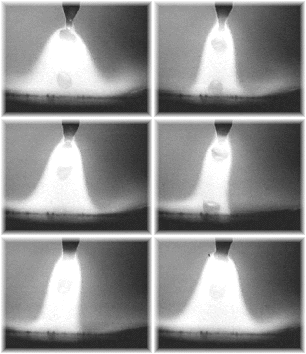 Its
fundamental arc physics that irrespective
of the potential wave form configurations, there are only so many electrons that
can be squeezed into a MIG wire and across an arc, Its
fundamental arc physics that irrespective
of the potential wave form configurations, there are only so many electrons that
can be squeezed into a MIG wire and across an arc,
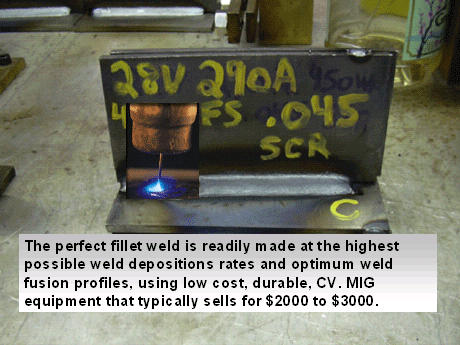
Using
an 0.045 or 0.052 wire the typical maximum
weld speed for a 1/4 fillet is
20 to 22 inch/min.
The
bottom line. With the MIG process a stable, optimum bell shaped weld plasma is
desirable as the bell shaped plasma provides good coverage of the weld area and
its plasma less condensed than a narrow concentrated plasma profile that result
in a digging weld.
Welding
steels thicker than 6 mm. When using spray
and large diameter MIG wires bigger than 0.045 and the requirement is high deposition
rates > 14 lb/hr, a typical spray weld current range of 380- 400 amps is typical.
With the pulsed mode, the energy is generated from both the peak and low
back ground current. To compensate for the low back ground current that is usually
50% of the weld cycle, an extra high peak current of > 460 amps is typical.
High wire feed rates require high pulsed frequency . Combine that high pulsed
frequency with the high peak and you can understand why the pulsed arc at specific
settings can get very agitated resulting in a narrow, concentrated agitated pulsed
plasma, a plasma which in this case had more in common with a plasma cutting arc
than it did with a MIG welding arc,
THE
RESULTING ARC PLASMA FROM THE LINCOLN POWER WAVE POWER SOURCE LOOKED MORE SUITABLE
FOR PLASMA CUTTING THAN FOR A CONTROLLED, STABLE MIG WELD WITH A SUITABLE WELD
PROFILE.
YOU MAY ASK WHY WAS THIS POWER SOURCE NOT TRIED BEFORE BEING
SELECTED FOR THE AXLE ROBOT CELLS. PERHAPS THE WELD ENGINEER RESPONSIBLE, BELIEVED
IN WHAT THE LINCOLN SALES REP HAD TOLD HIM.
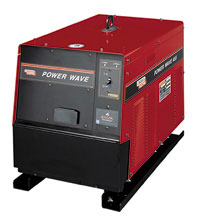 As
the down cast Lincoln engineer walked towards the plant exit with his lap top
and its unique Power Wave Form software cradled in his arms, I who have little
patience for the universal, sales induced, bovine fecal weld matter that seems
to ooze out of some companies, and being a pragmatic thick skinned Manchurian,
(means born in the industrial heart land of Manchester. UK) decided to pour a
little salt on the engineers wounds.
As
the down cast Lincoln engineer walked towards the plant exit with his lap top
and its unique Power Wave Form software cradled in his arms, I who have little
patience for the universal, sales induced, bovine fecal weld matter that seems
to ooze out of some companies, and being a pragmatic thick skinned Manchurian,
(means born in the industrial heart land of Manchester. UK) decided to pour a
little salt on the engineers wounds.
I
asked the Lincoln rep, "don't you think it's a little ridiculous that at
the end of the day, your costly Power Wave pulsed equipment provides inferior
weld results to your traditional DC 400 amp MIG power source which is more durable
and can be purchased for 30% of the price of a Power Wave"? The
Lincoln rep did not reply to my question, he just shrugged his sagging shoulders
and left looking like a wet blanket.
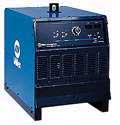 SOME
WELD COSTS AND BENEFITS: The
lower cost, traditional Lincoln CV. DC. 400 amp power source, or a Miller Delta
Weld power source used on this axle application would produce spray transfer welds
with superior weld fusion profiles and reduce the weld cycle time by 20%. SOME
WELD COSTS AND BENEFITS: The
lower cost, traditional Lincoln CV. DC. 400 amp power source, or a Miller Delta
Weld power source used on this axle application would produce spray transfer welds
with superior weld fusion profiles and reduce the weld cycle time by 20%.
 THE
LINCOLN POWER WAVE SAGA CONTINUED WHEN
WELD CRACKS OCCURRED IN THE AXLE WELDS. THE
LINCOLN POWER WAVE SAGA CONTINUED WHEN
WELD CRACKS OCCURRED IN THE AXLE WELDS.
After the Lincoln rep left we
went back to using a lower wire feed, less digging pulsed setting for the 1/4
(6 mm) fillet welds. A few axles were then pulsed welded with the Power Wave at
the low robot weld travel speed of 17 ipm.
After
I got rid of the undercut and large end craters with the conservative pulsed settings,
I then place my attention to the Ford weld specification for the truck axles.
The weld spec required a "macro examination" of a specific amount of
axle fillet welds. A measurement of the surface fillet weld cross section was
also required to ensure the minimum weld size dimensions were being attained.
In
evaluating the Lincoln Power Wave weld cross sections from the axle pulsed welds.
I noticed even at the lower pulsed settings the penetration was still deep and
narrow and "center weld hot cracks" had occurred in more than
20 % of the axle weld samples we tested.
Due
to the narrow, pulsed deep weld penetration profiles and restrained high tensile
steel weld joints, we were getting classic "hot cracks" in the narrow
root section of the deep penetrating axle welds.
As
we had minimal weld test equipment at the robot company, I had the University
of Colorado metallurgy department verify that the axle weld cracks did result
from the poor pulsed weld profiles. They quickly provided written confirmation.
The center weld cracks
were not a surprise from the Lincoln Power Wave pulsed welds, I had previously
complained and provided written report to the axle company management about the
poor pulsed weld depth to width ratios and concern for hot weld cracks.
Before we produced any more axles I notified my management, who then notified
the axle manufacture management of the pulsed production and weld crack issues.
We informed the axle company that the use of the Lincoln Power Wave pulsed mode
would result in deep, narrow weld fusion, and this poor weld profile combined
with the high strength steels and highly restrained weld joints was a classic
set up for potential hot center cracks. At this time I requested to call a hold
on the project.
The
robot project manager and I flew to Michigan where we had a meeting with the axle
company corporate management and the responsible engineers. I explained to these
personnel that their choice of the Lincoln Pulsed PowerWave, and the pulsed weld
parameters utilized were creating weld cracks and reducing the axle cycle times
by approx. 20 to 25% . I explained that if they complained about the Power Wave
weld equipment to Lincoln, I believed Lincoln would have no choice but to exchange
the four Power Wave power sources for their conventional CV. MIG equipment. If
the axle company would make the power source change we could get the desired weld
cycle times, eliminate future potential weld crack issues and reduce future liability
concerns for axle failures. The axle company management thanked us for the data
and said they would consider the matter.
WITH
MOST ROBOT MIG WELD PROBLEMS,
IT'S THE HUMAN ELEMENT
THAT'S ALWAYS THE ROOT CAUSE OF
MOST WELD ISSUES.
The
bottom line: This axle company employed a weld engineer who lacked weld process
expertise. (Similar to the Chrysler story). This engineer was no different from
many of Detroit's engineers who when requiring weld answers, seek advice from
sales rep. This engineer was now in a difficult position as the production schedule
was being delayed and he did not want to loose face in front of his management.
So he insisted the PowerWave was not the cause of the issues.
By
the way this engineer never came out to our facility to view or participate with
the weld test, which was quite remarkable when you consider that Ford was the
customer and the fact that these robots were going to produce a million axles
each year.
Like
many auto / truck companies, the Axle company management were lost without the
expertise of the individual that had caused the selection of the useless Lincoln
equipment.
The engineer would not back down from his Lincoln, Power
Wave equipment selection and after we left, he convinced his managers that irrespective
of the technical facts, the University of Colorado weld report and the numerous
weld crack samples presented, that he had made the right weld equipment choice.
The weld equipment decision was now cast in concrete and again Lincoln was of
the responsibility hook.
Meanwhile
as the axle company could not take immediate delivery of the robots. The robot
company I worked for was asked to weld a few thousand axles. During this manufacturing
period at our facility, I noted the center weld cracks continued. No one I discussed
this with seemed to want to take this issue to a higher level. I left the robot
company a short time later with the weld cracks still occurring. As I happen to
be a catholic with a conscience. I sent a registered letter to one of Ford's lawyers
in Detroit. In the letter I spelt out my concerns with the axle weld cracks on
their trucks. The lawyer never replied.
Could it be
that Ford did not get to hear, or did not want to hear about it's axle weld issues.
This was the time when tires were
falling apart and killing people. Is
it possible that Ford would rather wait to see how many axles fail on it's trucks
and how many life's are lost before it decides what action has to be taken.
Or
perhaps Detroit's best selling trucks will die of rust before the axle weld cracks
can propagate to failure.
WITH
ALL ENGINEERING DECISIONS IT PAYS TO BE OPEN MINDED, IT ALSO PAYS TO KNOW THE
PROCESSES THAT CREATE THE PROFITS ON THE SHOP FLOOR. ONE DAY SOON I WILL WRITE MY LAST BOOK AND CALL IT,
"IMAGINE A WELD SHOP THAT CAN RUN
WITHOUT THE INFLUENCE OF A SALESMEN"
IS
THIS WEB STORY RELATED?
2004
Ford Explorer:
Rear Axle Problem,
Hi all. I wanted to know if anyone has any advice
or if this problem has happened to you. We have a V8 2004 Ford Explorer that we
bought in August of 2003 and we have to get a new rear axle put on which fortunately
is covered under warranty. The mechanic told me the weld failed. I haul my bumper
pull 2 horse trailer about 2x monthly (since Oct. 2003) with my 1200lb Quarter
Horse loaded. How could this happen to a new vehicle? Is it my fault for expecting
it to haul my trailer? I know other people who haul their horses with Explorer's
and have never had any problems. Is this vehicle of ours a lemon? I would like
to know what you all think! Thanks!!!
2015: IS THIS CHRYSLER AXLE WELD ISSUE RELATED:
CHRYSLER: IMPORTANT SAFETY RECALL N26 / NHTSA 13V-239 ..This notice applies to vehicles (VIN: xxxxxxxxxxxxxxxxx). This notice is sent in accordance with the requirements of the National Traffic and Motor Vehicle Safety Act.
Chrysler has decided that a defect, which relates to motor vehicle safety, exists in some 2012 model year RAM Truck Cab Chassis (4500/5500 series) trucks equipped with four wheel drive.
The problem is the front axle tube welds on the trucks may not have been welded correctly during the manufacturing process. Improperly welded front axle tubes could allow the differential housing to rotate under high torque operating conditions while in four wheel drive. Should the front axle tube welds break, the differential could rotate and cause the front propeller shaft universal joint to break. This can result in a loss of motive power or damage to surrounding components if the propeller shaft continues to spin after separation. This could cause a crash without warning.
| |