Robot
Welding. Exhaust Hanger Brackets
with Panasonic Equipment.
FOR
SIX WEEKS, THE PANASONIC TEAM COULD NOT GET THEIR ROBOT TO PRODUCE TWO SIMPLE
WELDS.
 For
me it was another one of those annoying Japanese, robot applications. Thanks to
the Panasonic engineers, we had another simple weld application made unnecessarily
complex. The Honda part supplier had the robot for six weeks and in that time
period neither the Panasonic robot personnel or the Panasonic robot integrator
could get the robot to consistently place two small welds, 15 mm in length, on
a carbon steel rod to a thin gage galvanealed part (commonly called, exhaust bracket).
For
me it was another one of those annoying Japanese, robot applications. Thanks to
the Panasonic engineers, we had another simple weld application made unnecessarily
complex. The Honda part supplier had the robot for six weeks and in that time
period neither the Panasonic robot personnel or the Panasonic robot integrator
could get the robot to consistently place two small welds, 15 mm in length, on
a carbon steel rod to a thin gage galvanealed part (commonly called, exhaust bracket).
The exhaust hanger
bracket was designed by engineers at Honda. I am sure the Honda engineers who
designed the part had no idea how their MIG weld process ignorance also contributed
to some of the welding issues generated.
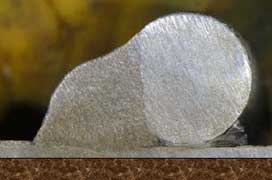 The
round carbon steel rod was 5/16 diameter and the thin gage galvanealed bracket
the rod was welded to was only 0.047 thick. Think about it, you have lack of fusion
concerns for the rod which is 5/16 thick, and weld burn through concerns for the
thin part 0.047.
The
round carbon steel rod was 5/16 diameter and the thin gage galvanealed bracket
the rod was welded to was only 0.047 thick. Think about it, you have lack of fusion
concerns for the rod which is 5/16 thick, and weld burn through concerns for the
thin part 0.047.
Poor
weld design is common in the auto / truck industry. I have yet to meet a designer
who has MIG welding process expertise. It's also a sad reflection today, that few
designers of auto components take any interest or the time to read about the weld
processes they recommend to join the parts they design.
After six weeks of playing around with the weld settings, the Panasonic and integrator
team could only produce the following;
[] inconsistent weld profiles,
[]
welds with porosity,
[] welds with burn through
[] welds with lack of
weld fusion.
After wasting thousands of dollars on loss of productivity
and weld rework the Panasonic people gave up and left the plant. The exhaust company
was more than concerned, there were five days left before production had to begin
on the Honda parts. The very frustrated plant manager gave me a call.
After
spending a few hours of reviewing the robot welds.
I made the following observations.
[]The
welds produced by the Panasonic personnel and integrator were too small. The short
circuit, fast freeze, undersize welds were the primary cause of the excess weld
porosity. I changed the weld size, this change resulted in more forgiving welds
that had less less opportunity for weld porosity, however the Panasonic welds
produced were still inconsistent.
[]
As with many Panasonic robot applications, the weld inconsistency was readily
noted in the arc sounds. This inconsistency was a direct result of the performance
of the Panasonic Inverter power source.
This
power source provided two outputs one for straight CO2 and the other for argon
mixes. With welds that have an arc on time of less than 3 seconds, it's important
that the weld equipment used has the capability of providing "consistent
out put" for the robot weld start data, the weld data, and the end weld data.
This power source could not provide this basic function with the low parameters
utilized. I changed the weld mode and settings on the equipment, and was able
to find settings that although were not recommended by Panasonic proved to be
more consistent. It was not a 100% however the new data improved the consistency
and stability for the small welds.
[]
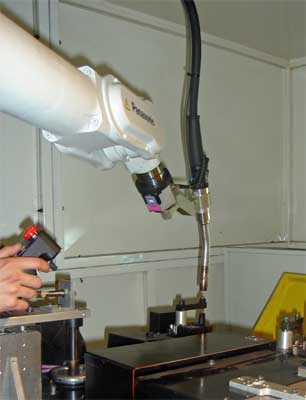
The fixture designed by the integrator did not allow for ideal positioning of
the MIG gun. As the Panasonic integrator gave up on his responsibility to this
customer, my fixture recommendations were made by the customer;s maintenance department.
 []
The Panasonic MIG
gun contact tip bore was on the minus size while the USA made MIG wire diameter
was on the plus size but still within spec. Occasionally the MIG wire was restricted
by the gun contact tip bore. I relieved this situation by drilling and increasing
the tip bore diameter on the Panasonic tips. I thought it was ridiculous to have
Panasonic guns in North America and recommended my client change to a Tregaskis
gun.
[]
The Panasonic MIG
gun contact tip bore was on the minus size while the USA made MIG wire diameter
was on the plus size but still within spec. Occasionally the MIG wire was restricted
by the gun contact tip bore. I relieved this situation by drilling and increasing
the tip bore diameter on the Panasonic tips. I thought it was ridiculous to have
Panasonic guns in North America and recommended my client change to a Tregaskis
gun.
[] Small
welds require a higher degree of weld accuracy. The Panasonic cell lacked touch
sensing or arc tracking and had no automated TCP control for the robot.
My
changes took about approx. 20 hours to complete. After the changes were made and
the weld process data was recorded, the company recognized that the daily success
of this operation required no deviation from my recommendations. To ensure consistent
acceptable weld results, I implemented my seven step robot process control program.
(Part of my self teaching and process control welding training package)
Finally seven weeks after the robot was delivered, the robot finally attained
daily acceptable weld quality and productivity. I charged the company for a weeks
work, about $5000 and I am still waiting for Panasonic and Honda engineers to
send a thank you card.