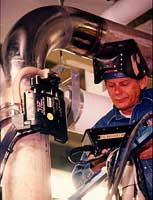
www.weldreality.com
Written by Ed Craig EMail ecraig@weldreality.com

THE TIP TIG PROCESS IS NOW
AVAILABLE IN NORTH AMERICA.
TIP TIG enables
superior
nickel quality welds
than TIG welds at Pulsed MIG wire feed rates.
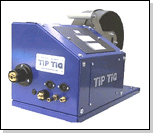
If
you want all position, defect free welds at superior quality than conventional
TIG, Pulsed MIG or the flux cored process and you would like to produce all position
weld deposition rates equal to pulsed MIG and flux cored, consider the TIP TIG
process. A five minute TIP TIG demo will show any weld professional that when
welding in any weld position, thin or thick metals, any alloys and any weld, clad
or brazed application, the TIP TIGprocess is the world's most cost effective process
for producing defect free welds.
THE
NORTH AMERICAN, PATENT PENDING, ADVANCED
TIP TIG PROCESS,
IS THE WORLD'S MOST EFFECTIVE WELD, CLAD AND BRAZING PROCESS. TIP TIG IS AN EASY
PROCESS TO USE AND ALWAYS DELIVERS SUPERIOR WELD QUALITY THAN TRADITIONAL TIG
/ PLASMA WELDS. THE BONUS FOR THE WELD SHOP IS WHILE GETTING THE ULTIMATE IN TIG
WELD QUALITY, YOU ARE GETTING IT 4 TO 8 TIMES FASTER THAN A TIG WELD:
The
semiautomatic TIP TIG process can be used with
either TIG - Plasma or a laser. TIP TIG will always result in superior weld /
clad quality and superior mechanical properties. It does not matter what the application,
the weld position, or the alloy to be welded is, TIP TIG will deliver the ultimate
attainable weld quality on all Carbon Steels, Stainless, Aluminum, Inconel, Titanium,
Hastelloy, Stellite, Duplex, Low and High Alloy Steels, Tool Steels and Cast Steel
welds and clad applications.
 The
Fossil and Nuclear industry will never attain the construction weld quality or
productivity (10 to 40 times faster than manual TIG) that the ATT manual and automated
weld process can deliver. Oil Platforms - Ship Yards - Naval Vessels and Submarines
- The Space and Aircraft Industries - Cryogenic Vessels - Petro Chemical - Refining
- Waste to Energy - Industrial Processing - Pulp and Paper - Military Equipment
- Medical Equipment - Food and Beverage, none of the North American industries
have in their weld shops a weld process that can deliver the weld quality / productivity
attainable from the easy to use, semiautomatic ATT process. The
Fossil and Nuclear industry will never attain the construction weld quality or
productivity (10 to 40 times faster than manual TIG) that the ATT manual and automated
weld process can deliver. Oil Platforms - Ship Yards - Naval Vessels and Submarines
- The Space and Aircraft Industries - Cryogenic Vessels - Petro Chemical - Refining
- Waste to Energy - Industrial Processing - Pulp and Paper - Military Equipment
- Medical Equipment - Food and Beverage, none of the North American industries
have in their weld shops a weld process that can deliver the weld quality / productivity
attainable from the easy to use, semiautomatic ATT process.
It does not matter what the metal to be welded is, or the degree of all position
weld difficulty. No other available global weld / clad process, will compete with
the TIP TIG process in delivering the combination of defect free welds, optimum
external weld quality, optimum mechanical properties with cost effective weld
deposition rates.
Why be concerned about the skilled welder shortage when the moderate priced TIP
TIG process is easy to use on the most difficult applications. PQR's will be easy
to produce as two simple amp / wire feed weld procedures will weld most of your
manual or automated applications. It takes about one hour to learn the one handed
TIP TIG techniques. TIP TIG will dramatically reduce your weld rework costs and
reduce your product liability concerns as it always will deliver the optimum in
weld quality. There is no weld smoke issues and no concerns for spatter. In contrast
to most other process it will provide less weld heat input. .
If highly cost effective, defect free welds with superior weld appearance are
important to you. Click for TIP TIG weld information.
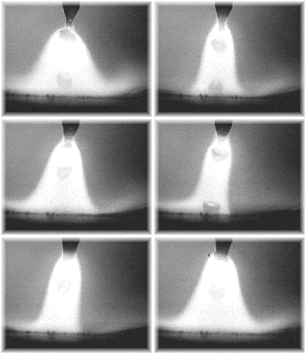
WELDING,
NINE PERCENT NICKEL
CRYOGENIC APPLICATIONS.
A
common application in which austenitic stainless and 9% nickel steels is in the
construction of cryogenic, liquefied natural gas (LNG) containers. These containers
can carry liquid argon, natural gas, helium, oxygen, nitrogen etc. These liquid
gases are usually in an approximate temp range of -300 to -450F. Carbon steels
and alloy steels have poor toughness and ductility at low temperatures. The alloy
steels with nickel, austenitic steels typically 304 - 304L 316 - 316L - 347 and
aluminum alloys all have excellent low temperature toughness.
Strict welding
regulations are applied to welding cryogenic applications. The weld metal properties
should contain low nitrogen, low ferrite, low carbon and high nickel. Filler metals
such as Nickel Chrome Molybdenum, Nickel Chrome Iron or high alloy austenitic
electrodes.The Nickel alloy consumables have a coefficient of thermal expansion
that is close to the 9% nickel this reduces the risk of thermal fatigue in applications
subject to thermal cycling. Typically the mechanical properties of nine percent
nickel will be higher than those of the weld consumables utilized. This requires
special consideration to weld qualification tests.
Note that with the
30X in centrast to the 30XL (low carbon grades). The higher the carbon the lower
the impact toughness.Shop built stainless steel cryo vessels in the USA are built
to ASME Boiler Pressure Vessel Code Section V111. Field erected vessels may use
the API 620 Q. Austenitic stainless accounts for the majority of metals used for
cryo applications. The rest of the applications use 5 to 9% nickel or aluminum.
Where high strength is required nine nickel may be chosen instead of an austenitic
steel. Its important to remember that nine percent nickel is an alloy that can
rust.
WELDING AFFECTS ON STAINLESS STEEL AND NINE PERCENT NICKEL
Keep
the carbon in the rage <0.03%. Low carbon superior toughness.
With
SMAW, Lime electrodes provide higher low temp toughness than the titania electrodes.
Weld
Inclusions. Slag inclusion can lower low temp toughness. Keep this in mind when
comparing weld processes. The two best processes for toughness are GTAW and GMAW.
As
porosity or inclusions are a result of an oxide reaction its logical when MIG
welding to use a low reactive gas mix.For stainless applications forget that argon
2% oxygen mix recommended by the gas companies, use Ed's stainless mix, argon
with 2 CO2, (more
info at gas section, www.weldreality.com). The argon CO2
mix is much less oxidizing and does not have enough CO2 to add to the carbon content
of the weld. Use TIP TIG weld with TIG quality at MIG wire feed rates with inert argon.
Nitrogen
pick up will increase the strength of the stainless welds however it decrease
the low temperature toughness.
If
using SAW for stainless, its difficult to meet the weld impact requirements on
applications below - 300 F, consider MIG.
If
the stainless pipe ID root weld finish is important, automated TIG systems use
low (none pulsed) current for the root.The fill passes can then if required be
made with the MIG process. Argon and argon hydrogen mixes are used for the TIG
welds.
Nine
percent nickel is often used for economic reasons for large plate, cryo pressure
vessel applications down to -320 As mentioned this metal can rust, so this alloy
cannot be used on applications where contamination is a concern.
Nine
percent nickel cryo vessels are built to ASME Boiler Pressure Vessel code SectionV111.
Two
material specs are used for the common nickel plates.
[1] ASTM SA 553/SA
553M Spec for pressure vessel plates. Alloy steels Quenched and tempered 8-9%
Nickel.
[2] ASTM SA 353/SA-353M Spec for pressure vessel plates. Alloy Steels
Doubled Normalized and tempered.
ASTM.
AS 553 and SA 353 have the same chemistry 8.5-9.5 nickel the yield strength of
353 is 75 ksi to 85 ksi for the 553.
Most
pressure vessel plates are QT 553.
- Use
Ed's Nickel MIG gas mix visit the gas section at www.weldreality com for more info.
Weld
consumables available from Sandvik, and Inco Alloy. Ni CR/ Ni Cr Fe/ Ni-Cr-Mo
and 16.13 CMnW ( 16.5 Cr - 12.6 Ni - 6.9 Mn - W 3.3 bal Fe).
Weld
procedure qualifications for 9% nickel according to section 1X of the boiler code
requires impact test made at -320F or the lower operating temp. The impact test
covers
the weld d HAZ. Transverse tensile and bend tests are also req.
For
more nickel data, visit Nickel Development Institute. Sandvik and
Inco Alloy Intentional
Note: A portion of
this data is from an Avery and Parsons article. Weld Journal Nov 95.
| |