Written by Ed Craig
Home page of www.weldreality.com
ASTM
Welding A403-A643 Carbon Low Alloy Steels.
Bar
Plate and Pipe..
ALL ELECTRODE RECOMMENDATIONS MADE AT THIS SITE REQUIRE
WELD QUALIFICATION BEFORE
THE WELD CONSUMABLES ARE APPROVED.
Note:
When you see high tensile weld electrodes required, this is usually an indication
that pre heat interpass and post heat treatment is required for the welds
 Fatigue: Fatigue:
The ability of a metal or weld to withstand repeated loads. Fatigue failures occur
at stress levels less than the metal or weld yield strength. Some things that
can influence fatigue failure:
- Excess
weld profiles.
- Welds
which cause undercut.
- FCAW
or SMAW slag inclusions.
- Lack
of weld penetration.
- Excess
weld heat, typically from multi-pass welds without inter-pass temp controls.
- Items
to a part that adds restraint while welding.
- Items
added to a part that can concentrate stresses in a specific location.
- Incorrect
selection of filler metal, weld too weak or weld too strong.
When
welding low and medium carbon steels, the 70XX electrodes and E70S-3-6 MIG wires
and E7XT-X flux cored electrodes can be used. When welding low alloy 1 1/4
Cr 1/2 Mo and 2 1/4
Cr 1 Mo with up to 0.05% max carbon, typically 8018-B2L / 9018-B3L (L = low carbon)
can be used. When welding higher strength alloys or when tempering and quenching
are required to attain the higher strengths the higher carbon 8018 B2 and 9018
B3 electrodes are utilized.
| Steels | Yield
ksi
MPa | Tensile
ksi
MPa | Description | Preheat
Post heat | UNS | Chemistry
weld data | ASTM
403 |
|
|
Austenitic Stainless
Pipe |
|
|
see pipe |
ASTM
405 |
|
|
Cr
Mo pipe |
|
|
see pipe |
ASTM
409 |
|
|
Austenitic
stainless pipe |
|
|
see
pipe |
ASTM
A410 |
|
|
pressure
vessel plate |
|
|
E8018-C3 |
ASTM
412
grade 201 -202
|
|
|
Stainless
plate |
|
|
E308 |
ASTM
413
Grade # 30.
Proof Coil grade # is strength |
| | welded
steel chain general purpose , low carbon steel not recommended for over head lifts |
| | |
A413
Grade # 43. High Test |
| | welded
steel chain general purpose , low carbon steel Stronger than grade 30.Not recommended
for over head lifts |
| | |
A413
Grade # 70. Transport Binder |
| | welded
steel chain general purpose , low carbon steel heat treated
Stronger than
grade 43.Not recommended for over head lifts |
| | |
ASTM
A414
A-B-C-D
E-F-G |
|
|
Flange
and firebox sheet |
|
|
All
grades except G
E60XX
E70XX
E70S-X
E71T-1
Grade G
E7018-A1 |
ASTM
420
|
|
|
Carbon stl and nickel
stl pipe fittings |
pre heat
100 - 200F |
|
8018
80S-D2 |
ASTM
423 |
|
|
Low
alloy tubes |
pre heat 100-200F |
|
8018W |
ASTM
A425 |
|
|
Hot
rolled strip |
|
|
E60XX
E70XX
E70S-X
E71T-1 |
ASTM
A426
|
|
|
Cr Mo Pipe |
pre
heat 100 - 600 F |
|
see pipe |
ASTM
430 |
|
|
Austenitic
stainless pipe |
|
|
see
pipe |
ASTM
A434 |
|
|
AISI
Quenched and tempered steel bars |
|
|
|
A434-BB
|
65-90
448-620 |
90-110
620-758 |
|
|
|
Contact
Alloy Rod for special electrode
T4130 |
A434-BC
|
80-110
|
105-130
|
|
|
|
Contact
Alloy Rod for special electrode
T4130 |
A434-BD
|
100-130
|
130-155
|
|
Preheat
250 - 350F |
|
|
ASTM
A440 |
|
|
High
strength structural |
|
|
E7018
E70S-X
E71T-1 |
ASTM
A441 |
40-50
275-344 |
60-70
413-482 |
High
strength low alloy structural steel used often for bridges |
Preheat
>25mm 100F >50mm 200F |
K1211 |
carbon
0.22
Si 0.4max
Mn 0.85/1.25
Cu
V 0.2
E7018
E70S-X
E71T-1
If weathering steel unpainted
E8018-W
E80T1-W
|
SMAW and GMAW Mechanical Strength
E6010 Minimum Yield
50,000 psi Minimum Tensile 62,000 psi.
E6011 Minimum Yield 50,000 psi Minimum
Tensile 62,000 psi.
E7010 Minimum Yield 60,000 psi Minimum Tensile 72,000
psi.
E7018 Minimum Yield 60,000 psi Minimum Tensile 72,000 psi.
The commom
MIG E70S-3-6 wires.
Minimum Yield 60,000 psi Minimum Tensile 72,000
psi.
Mechanical
Strength of Gas Shielded Flux Cored Electrodes, reference ANS I /AWS A5.29
1198
Specification. Low Alloy Steel Electrodes for Flux Cored Arc Welding
| AWS
Classification | Tensile
ksi | Tensile
MPa | Yield
ksi | Yield
Mpa | | E6XTX-X-XM | 60
- 80 | 410
- 550 | 50 | 340 |
| E7XTX-X-XM | 70
- 90 | 480
- 620 | 58 | 400 |
| E8XTX-X-XM | 80
- 100 | 550
- 690 | 68 | 470 |
| E9XTX-X-XM | 90
- 110 | 620
- 760 | 78 | 540 |
| E10XTX-K9-K9M | SEE
SPEC | | 88 | 610 |
| (M)
means an argon mix req, 75 to 80 argon balance CO2 | All
DCEP | E71T-1
Second number
1 = all position
| E70T-1
Second number
0 = flat and horizontal | |
 What is Brittleness? What is Brittleness?
The ease at which the weld or metal will break or crack without
appreciable deformation. When a metal gets harder it becomes more brittle. Preheat,
inter-pass temp controls and post heat all are designed to reduce the potential
for brittleness.
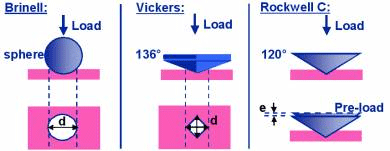
How do you measure Hardness?.
The hardness tester forces a small sphere (Brinell,
HB), a diamond pyramid (Vickers, HV) or a cone (Rockwell C, HRC) into the surface
of a metallic material. The indentation is then measured.
 PRE - INTERPASS OR POST HEAT? PRE - INTERPASS OR POST HEAT?
Many manufactures of parts and equipment containing ASTM steels will not use the
recommended pre or post-heat treatments.
The
requirements for weld heat considerations is greatly influenced by many factors such as the
application, the governing specifications or codes, the plate conditions, plate
thickness, the weld consumables the weld procedures, the weld size and amount
of welds required.
In many cases the manufacturer that uses ASTM steels will find that it's not necessary
for the weld to match the mechanical properties of the steel, (its often better
for the weld to have more ductility than the plate) and therefore low hydrogen,
highly ductile SMAW E7018 / E70S-3-6 MIG wires or E7XT-X flux cored electrodes
are used.
When using the low hydrogen electrodes,
the pre and post heat treatment recommendations are frequently reduced or eliminated, however
from a weld quality perspective always ensure that the weld locations are dry,
the base metal is over 60 F, and that rust and mill scale is removed from the
weld area.
Its beneficial for all multipass welds
to not allow the multi-pass inter-pass weld temperatures to exceed 350 F.
Multipass welds will have an annealing affect on the welds and base metals and therefore the need for preheat will either be eliminated or reduced.
If you ignore the heat treat requirements as recommended by the metal specifications
ensure you use low hydrogen consumables then,
(a)
establish the PQR,
(b) qalify both the weld and HAZ mechanical properties.
|
Welding alloy steels often may require unique weld or
heat treat considerations. Compare the low alloy steels chemistry and mechanicals
with a standard A36 steel. Remember this site is only a guide, weld responsibility
starts with "you" First verify the weld consumable and then the material
heat treat recommendations.
What is
yield strength?
The stress that
can be applied to a base metal or weld without permanent deformation of the metal is the yield strength.
What is tensile strength? The
ultimate tensile strength is the maximum strength that the metal
or weld can withstand before failure occurs.
Metric Conversion 1000 psi = ksi x 6.894 = MPa
| Steels | Yield
ksi
MPa | Tensile
ksi
MPa | Description | Preheat
Post heat | UNS | Chemistry
weld data | ASTM
A442-55 |
>
30
206 |
55
- 75
379-517 |
Carbon
steel pressure vessel plate
CSA 300W-T
350W-T 350A-T
380W
HSS
380WT- HSS |
| K02202 |
carbon
0.22/0.24
Mn 0.6/1.1
Si 0.15/0.4
E7018
E70S-X
E71T-1 |
ASTM
A442-605 |
>32
220 |
60
- 80
413-551 |
| Preheat
>0.26 carbon
>25mm 100F |
K02402 |
carbon
0.24/0.27
Mn 0.6/1.1
Si 0.15/0.4
E7018
E70S-X
E71T-1 |
ASTM
447 |
| | Stainless
castings |
| | 309 |
ASTM
A444 |
| | Galvanized
sheet |
| | E6010
E70S-3 |
ASTM
451 |
| | Austenitic
stainless pipe |
| | see
pipe |
ASTM
452 |
| | Stainless
pipe |
| | see pipe
E308 |
ASTM
A455 |
<9.6mm
>37
9-13mm
>36
>13mm
>35 |
<9.6mm
75-95 9-13mm
73-93
>13mm
70-90 | High
strength manganese steel for pressure vessel plates |
preheat
carbon
0.26/0.3
100F
>0.3 carb 200F |
K03300 |
carbon
0.33
Si 0.10
Mn 0.85/1.29
E7018
E70S-X
E71T-1 |
ASTM
A457 |
| | stainless
plate sheet strip |
| | E347 |
ASTM
A458 |
| | stainless
bars |
| | E347 |
ASTM
A469 |
| | low
alloy forgings |
pre heat 100 to 400 F |
| E8018
to E1218 |
ASTM
A470
|
| | low
alloy forgings |
pre heat 100 to 400 F |
| E8018
to E1218 |
ASTM
A473 |
| | Austenitic
Stainless forgings |
| | |
ASTM
A477 |
| | austenitic
stainless forgings |
| | E347 |
ASTM
A479 |
| | pressure
vessel austenitic stainless parts |
| | |
ASTM
A486
|
| | steel
castings highway bridges |
| | |
| A486-70 |
| | | preheat
carbon >0.2 <25mm 100F >25mm 250F |
| E7018
E70S-X
E71T-1 |
| A486-90 |
| | | | | E808-B2 |
ASTM
A487 other grades |
| | Casting
for
pressure service |
| | |
| A487-2N |
| | | check
for pre/post heat req |
| E7018-A1
or
E8018-B2 |
| A487-4N |
| | | check
for pre/post heat req |
| Flux
cored
E4130 |
| A487-6N |
| | | check
for pre/post heat req |
| Flux
cored
E4130 |
| A487-7Q |
| | | check
for pre/post heat req |
| Flux
cored
E4130 |
| A487-8N |
| | | check
for pre/post heat req |
| E9018-B3
E90T5-B3 |
| A487-9N |
| | | check
for pre/post heat req |
| E9018-B3
E90T5-B3 |
 When
mill scale is a problem, what MIG or flux cored weld parameter will the welder have to change
and why? The solutions are in Ed's books. When
mill scale is a problem, what MIG or flux cored weld parameter will the welder have to change
and why? The solutions are in Ed's books.
STRESS
RELIEVING (SR) BASIC GUIDELINES:
- STRESS
RELIEF - CONTROLLED HEATING & COOLING TO REDUCE STRESS.
- STRESS
RELIEF MACHINED PARTS FOR DIMENSIONAL STABILITY.
- STRESS
RELIEF SLOW HEATING AND COOLING REQUIRED
- CONFIRM
WITH CODE SPECIFICAIONS FOR STRESS RELIEF REQUIREMENTS.
| TYPICAL
STRESS RELIEF SOAK TIME
ONE HOUR PER INCH OF THICKNESS | SR
HEAT & COOL RATE PER HOUR 400oF 204oC DIVIDE THICKER PART |
PARTS
OF DIFFERENT THICKNESSES
SR MAX TEMP DIFFERENCE 75oF 24oC |
STRESS
RELIEF CARBON STEELS 1100oF 593oC
TO 1250oF 677oC |
STRESS RELIEF
CARBON 0.5% Mo
1100oF 593oC TO 1250oF 677oC | SR
1% CHROME 0.5% Mo
1150oF 621oC TO 1325oF 718oC |
SR 1.25
% CHROME 0.5% Mo
1150oF 621oC TO 1325oF 718oC | SR
2% CHROME 0.5% Mo
1150oF 621oC TO 1325oF 718oC |
SR 2.25
% CHROME 1% Mo
1200oF 649oC TO 1375oF 746oC | SR
5% CHROME 0.5% Mo
1200oF 649oC TO 1375oF 746oC |
SR 7% CHROME
0.5% Mo
1300oF 704oC TO 1400oF 760oC | SR
9% CHROME 1% Mo
1300oF 704oC TO 1400oF 760oC | SR
12% CHROME 410 STEEL
1550oF 843oC TO 1600oF 871oC | SR
16% CHROME 430 STEEL
1400oF 760oC TO 1500oF 815oC |
SR 9% NICKEL
1025oF 552oC TO 1085oF 585oC | FOR
300 SERIES STAINLESS SR WILL
RESULT IN CARBIDE PRECIPITATION |
WITH
LOW CARBON 300 SERIES
MAX SR 1050oF 566oC | SR
400 SERIES CLAD STAINLESS
1100oF 593oC TO 1350oF 732oC |
SR
CLAD MONEL INCONEL Cu NICKEL
1150oF 621oC TO 1200oF 649oC | STRESS
RELIEF MAGNESIUM AZ31B 0
500oF 260oC 15 MIN | STRESS
RELIEF MAGNESIUM AZ31B
H24 300oF 149oC 60 MIN |
HK31A H24 550oF 288oC
30 MIN
HM21A T8-T81 700oF 371oC 30 MIN
|
MAGNESIUM
WITH MORE THAN 1.5%
ALUMINUM STRESS RELIEF | MAGNESIUM
CAST ALLOYS AM100A
500oF 260oC 60 MIN | AZ-63A
81A 91C & 92A
500oF 260oC 60 MIN | |
| | | | |
E-Mail
Feb 2007. Ed what affect does flame cutting API X-80 or 550 gr. pipe have on the weld HAZ?
Is 6010 a good root pass electrode for this material?
All X-80 materials are not created equal: They could be seamless quench
and tempered, or DSAW TMCP plate. You can get some seamless that will have high alloy
content that will produce a very hard HAZ, these alloys can be susceptable to hydrogen cracking. You
need to consider minimum preheat and interpass temp controls and possibly avoid cellulosic
electrodes such as 6010. The TMCP materials typically provide excellent results such as a soft HAZ from low minimum preheat.
| Steels | Yield
ksi
MPa | Tensile
ksi
MPa | Description | Preheat
Post heat | UNS | Chemistry
weld data | ASTM
A493 |
| | Bar
and Wire stainless |
depends
on grade |
| |
ASTM
A496 |
| | Reinforcing
wire |
200 to 300 |
| 9018m |
ASTM
A500 |
| | carbon
steel tube |
100 -200F |
| E70S-3
E7018 |
ASTM
A508
|
| | Forgings
pressure vessels |
| | E7018
E70S-X
E71T-1 |
ASTM
A511 |
| | austenitic
stainless tubes |
| | 3xx
series |
ASTM
A512 |
| | carbon
stl tubes |
| | E70S-3
E7018 |
ASTM
A513 |
| | carbon
and low alloy steel tubes |
100 - 200F |
| E70S-3
E7018 |
ASTM
A514 |
>
90-100
620-689 |
100-130
689-896 |
Quench
and tempered alloy steel plate High yields. This spec also applies to ASTM
A517 |
| | |
| A514-A |
| | Known
as
N-A-XTRA 100 |
| K11856 |
Carbon
0.15/0.21
Mn 0.8/1.1
Si 0.4/0.8
Cr 0.5/0.8
Zr 0.5/0.15
B
0.0025 |
| A514-B |
| | Known
as
T - 1 Type A |
| K11630 |
Carbon
0.12/0.21
Mn 1.0
Si 0.2/0.35
Cr 0.4/0.64
MO 0.15/0.25
V 0.03/0.08
Ti0.01/0.03
B 0.0005
/0.005 |
| A514-C |
| | Known
as
JALLOY-S-100 |
| K11511 |
Carbon
0.1/0.2
Mn 1.1/1.5
Si 0.15/0.3
MO 0.2/0.3
B 0.001/0.005 |
| A514-D |
| | | | K11662 |
Carbon
0.13/0.2
Mn 0.4/0.7
Si 0.2/0.35
Cr 0.85/1.2
Mo0.15/0.25
Ti 0.04/0.1
Cu 0.4
B 0.0015
to 0.005 |
| A514-E |
| | | | K21604 |
Carbon
0.12/0.2
Mn 0.4/0.7
Si 0.2/0.35
Cr 1.4/2.0
Mo 0.4/0.6
Ti 0.04/0.1
Cu 0.2/0.4
B 0.0015
to 0.005
SSS-100 |
| A514-F |
| | Typically
Called
T-1 Steel |
| K11576 |
Carbon
0.1/0.2
Mn 0.6/1
Si 0.15/0.35
Cr 0.4/0.65
Ni 0.7/1
Mo 0.4/0.6
V 0.03/0.08
Cu 0.15/0.5
B 0.006 |
| A514-G |
| | | | K11872 |
Carbon
0.15/0.21
Mn 0.88/1.1
Si ?
Cr 0.5/0.9
Ni 0.7/1
Mo 0.4/0.6
Zr 0.05/0.15
B 0.0025 |
| A514-H |
| | | | K11646 |
Carbon
0.12/0.21
Mn 0.95/1.3
Si 0.2/0.35
Cr 0.4/0.65
Ni 0.3/0.7
Mo
0.2/0.3
V 0.03/0.08
B 0.005 |
| A514-J |
| | | | K11625 |
Carbon
0.12/0.21
Mn0.45/0.77
Si 0.2/0.35
Mo 0.5/0.65
B 0.001
to 0.005 |
| A514-K |
| | | | K11523 |
Carbon
0.1/0.2
Mn1.1/1.15
Si 0.15/0.3
Mo0.45/0.55
B 0.001
to 0.005 |
| A514-L |
| | | | K11682 |
Carbon
0.13/0.2
Mn0.4/0.7
Si 0.15/0.3
Cr1/15/1.65
Mo0.25/0.4
Ti0.04/0.1
Cu 0.2/0.4
B 0.005
|
| A514-M |
| | | | K11683 |
Carbon
0.12/0.21
Mn0.4/0.7
Si 0.15/0.3
Ni 1.2/1.5
Mo0.45/0.6
B 0.001
to
0.005
|
| A514-N |
| | | | K11847 |
Carbon
0.15/0.21
Mn0.8/1.1
Si 0.4/0.9
Cr 0.5/0.8
Mo 0.25
Zr 0.05/0.15
B 0.0025 |
| A514-P |
| | For
all a514 welds keep multi-pass welds small to improve notch toughness. Keep heat
input low use stringers instead of weaves |
Preheat
for all A514 <13mm 50F<25mm
175F.
Don't exceed 200F inter-pass temp.
Always ensure oil or moisture removed before weld |
K21650 |
Carbon
0.12/0.21
Mn0.45/0.7
Si 0.4/0.9
Ni 1.2/1.5
For all A514 welds
E11018-M
E110S-1
E110T5-K4
E110T1-G
MIG alternative
E80S-D2
keep MIG spray volts low to reduce
Hydrogen
content. Use low
reactive gas mix like argon 10% C02. |
What is lamellar
tearing?
When welding,
the weld shrinkage stresses impose tensile strains in the steel plate or on inclusions
paralleled to the plate surface. The tensile strains can separate the inclusions
causing cracks. Excessive strains can further elongate the cracks. Carbon, manganese
and low alloy steels made at the mill with inadequate deoxidization are sensitive
to lamellar tearing. The potential for lamellar tearing increases with the amount
of inclusions in the plates being welded. Of special concern is when the inclusions
are parallel to the plate surface. More data in ASTM A770 / A770M Standard Spec
for through thickness tension testing of steel plates.
| Steels | Yield
ksi
MPa | Tensile
ksi
MPa | Description | Preheat
Post heat | UNS | Chemistry
weld data | ASTM
A515 |
| | pressure
vessel steel plate for medium to high temp service |
preheat
0.21 to 0.25 carb >50mm 200F
preheat 0.26 to 0.30 carb <50mm 100F >50mm
200F
preheat >0.3carb <25mm 100F 25 TO 50mm 200F >50mm 300F
|
| |
| A515-55 |
>30
206 |
55
- 75
379-517 |
| | K02001 |
Carbon
0.2/0.28
Mn 0.9
Si 0.15/0.4
E7018
E70S-X
E71T-1
|
| A515-60 |
>32
220 |
60
- 80
413-551 |
| | K02401 |
Carbon
0.24/0.31
Mn 0.9
Si 0.15/0.4
E7018
E70S-X
E71T-1 |
| A515-65 |
>35
241 |
65-
85
448-586 |
Similar
to
CSA 300W 300WT-350W
350ATY-380W-T |
| K02800 |
Carbon
0.28/0.33
Mn 0.9
Si 0.15/0.4
E7018
E70S-X
E71T-1 |
| A515-70 |
>38
262 |
70-
90 482-620 |
Similar
to
CSA 300W 300WT-350W
350ATY-380W-T |
| K03101 |
Carbon
0.31/0.35
Mn 0.9
Si 0.15/0.4
E7018
E70S-X
E71T-1 |
ASTM
A516 |
| | Pressure
vessel steel plate
AISI 1116 |
preheat
0.2 carb >50mm 100F
preheat 0.2 to 0.25 carb >25mm 100F >50mm
200F
preheat >0.26 TO 0.31carb 13/25mm 100F
>25mm
250F
post heat over 25mm 1200F is beneficial |
G11160 |
|
| A516-55 |
>30
206 |
55-75
379-517 |
| K01800 |
| Carbon
0.18/0.26
Mn 0.6/1.2
Si 0.15/0.4
E7018
E70S-X
E71T-1
|
| A516-60 |
>32
220 |
60-80
413-551 |
| K02100 |
| Carbon
0.21/0.27
Mn 0.6/1.2
Si 0.15/0.4
E7018
E70S-X
E71T-1
|
| A516-65 |
>35
241 |
65-85
448-586 |
Similar
to CSA 300W 350W 380W-T HSS |
K02403 |
| Carbon
0.24/0.29
Mn 0.85/1.2
Si 0.15/0.4
E7018
E70S-X
E71T-1 |
| A516-70 |
>38
262 |
70
- 90
482-620 |
Similar
to CSA 300W 350W 380W-T HSS |
K02700 |
| Carbon
0.27/0.31
Mn 0.85/1.2
Si 0.15/0.4
E7018
E70S-X
E71T-1 |
What is Ductility?
The amount that a metal or weld will deform without breaking.
Measured on welds by the % of elongation in a 2 inch 51 mm test piece. An E71T-1
flux cored electrode should result in a minimum of 20% elongation. An E70S--6
MIG weld should produce approx 22%.
What is Toughness?The
ability of the metal or weld sample at a predetermined temperature to withstand
a shock.The test for toughness measures the impact of a pendulum on a notched
specimen. You may see that the required impact properties for the metal or weld
are 20ft-lbf @ -20 F (27 j @ -29C)
| Steels | Yield
ksi
MPa | Tensile
ksi
MPa | Description | Preheat
Post heat | UNS | Chemistry
weld data | ASTM
A517 | >100
690 | | Quench
and tempered High strength alloy plate | | | produced
in accordance with ASTM A514 | ASTM
A517 | >100
690 | | Quench
and tempered High strength alloy plate | | | produced
in accordance with ASTM A514 | ASTM
A519 | | | carbon stl tubes | 100
to 400F | | 8018
9018
1118M |
ASTM
A521-CA
CC-CC1 | | | Die
Forgings | | | E7018
E70S-X
E71T-1 | A521
AA-AB
CE-CF
CF1 | | | | | | E8018-C3 |
A521
AE-AG
AH | | | | | | E11018M |
A521
AC-AD
CG
| | | | | | E8018-B2 |
ASTM
A523 | | | CARBON
STL PIPE | | |
E7018
E70S-3-6 | ASTM
A524 | | | carbon stl pipe | | | E7018
E70S-3-6 | ASTM
A526
A527
A528 | | | Galvanized
sheet metal | | | E6010
E7010
E70S-3
| ASTM
A529 | >42
289 | 60-80
413-586 | Structural
steel plate bars or shaped | | K02703 | Carbon
0.27
Mn1.2
Cu0.20
E7018
E70S-X
E71T-1 |
ASTM
A533 | | | Quenched
Tempered
pressure vessel plate | Preheat
>0.15 carbon >50mm 200F
Preheat 0.16/0.2 carbon 13/25mm 100F >25mm
250F
Preheat 0.2/0.25 carbon <13mm 100F >50mm 250F >50mm 400F
Post heat benefits <0.16
carb >13mm 1150F | | |
| A533-A | | | | | K12521 | Carbon
0.25
Mn1.15/1.5
Si0.15/0.4
Mo 0.6
|
A533-A
class 1 | >50 | 80-100
551-689 | | | |
CLASS 1
E8018-C3
E9018-M
E90T1-K2
E80S-D2
Class 2-3
E7018
E8018-C3
E11018-M
E110T-1-G | A533-A
class 2 | >70 | 90-115
620-792 | | | | |
A533-A
class 3 | >83 | 100-125
689-861 | | | | |
| A533-B | Same
mechanicals as A533-A | | | | K12539 | Carbon
0.25 max
Mn1.15/1.5
Si0.15/0.4
Ni 0.4/0.7
Mo0.45/0.6 For
class 1
E8018-C3
E9018-M
E90T1-K2
E80S-D2
Class
2-3
E7018
E8018-C3
E11018-M
E110T-1-G
|
| A533-C | Mechanicals
similar to A533-A-B | | | | K12554 | Carbon
0.25 max
Mn1.15/1.5
Si 0.4
Ni 0.7/1.0
Mo0.45/0.6
For
class 1
E8018-C3
E9018-M
E90T1-K2
E80S-D2
Class
2-3
E7018
E8018-C3
E11018-M
E110T-1-G | | A533-D | Mechanicals
similar to A533-C | | | | K12529 | Carbon
0.25 max
Mn1.15/1.5
Si 0.15/0.4
Ni 0.2/0.4
Mo0.45/0.6
For class 1
E8018-C3
E9018-M
E90T1-K2
E80S-D2
Class 2-3
E7018
E8018-C3
E11018-M
E110T-1-G
|
If
you are welding a carbon steel and you don't know what the composition is or what
the weld consumable should be, try the following:
-
If the metal is thicker than 1/4 (>6 mm,) preheat to 150F.
- Use
either an E7018 stick electrode, an 0.035 or 0.045 E70S-3-6 MIG wire.
- For your all
position welds an 0.045, E71T-1 electrode wire.
- For
MIG welding use an argon 10 to 20% CO2 mix.
-
For the flux cored use a mix with 20 to 25% CO2.
-
Ensure with multi-pass welds you use inter-pass temp control.
- Ensure the inter-pass
temp weld temperature does not exceed 300F.
- Use stringer passes.
-
If possible do a mechanical / destructive test of the weld samples.
-
If possible have the hardness and grain size checked after welding.
| Steels | Yield
ksi
MPa | Tensile
ksi
MPa | Description | Preheat
Post heat | UNS | Chemistry
weld data | ASTM
A537 |
| | Heat
treated Pressure vessel plate |
| | |
A537
class 1 |
40-50
310-344 |
65-90
448-620 |
Normal
Condition |
| KO2400 |
Carbon
0.24 max
Mn0.7/1.6
Si ?
Mn ?
Cr ?
Mo ?
Cu ?
E7018
E8018-C3
|
A537
class 2 |
46-60
|
70-100
|
Quenched
and tempered |
Preheat
<0.2 carbon 25/50mm 100F >50mm 200F
Preheat 0.2/0.24 carbon <50mm
200F >50mm 300F
|
| Carbon
0.24 max
Mn0.7/1.6
Si ?
Mn ?
Cr ?
Mo ?
Cu ?
E8018-C3
E9018-M
E91T-1 |
ASTM
A538 |
| | | | | |
A538-A
|
| | | | K92810 |
Carbon
0.3 max
Mn0.1max
Si 0.1max
Ni 17/19
Mo4/4.5
check other alloys |
| A538-B |
| | | | K92890 |
Carbon
0.3 max
Mn0.1max
Si 0.1max
Ni 17/19
Mo4.6/5.1
check other
alloys |
| A538-C |
| | | | K93120 |
Carbon
0.3 max
Mn0.1max
Si 0.1max
Ni 18/19
Mo4.6/5.2
check other
alloys |
ASTM
A539 |
| | carbon
stl tubes |
| | E7018
E70S-X
E71T-1 |
ASTM
A541 |
| | | | | |
| A541-1 |
| | Pressure
vessel forgings |
| | E7018
E70S-6
E7XT-X
depending on heat treat
E8018-C3
| | A541-1A |
| | | | | E7018
E70S-6
E7XT-X
depending on heat treat
E8018-C3 |
A541-2
-3-4-5-6 |
| | | | | E8018-C3
|
A541-2A
-3A-6A-7-
7A-7B-8-8A |
| | | | | E7018
E70S-6
E7XT-X
depending on heat treat E110T5-K4 |
ASTM
A542 |
| | Quenched
and tempered pressure vessel plate |
preheat
<25mm 200F <50mm 250 >50mm 300F
Postheat 1300F |
K21590 |
Carbon
0.15 max
Mn0.3/0.6
Si0.15/0.3
Cr2/2.5
Mo0.9/1.1 |
| A542-1 |
>85
586 |
105/125
723/861 |
| | | E110T5-K4 |
| A542-2 |
>100
689 |
115/135
792/930 |
| | | E110T5-K4 |
| A542-3 |
>75
517 |
95/115
655/792 |
| | | E110T1-K3 |
| A542-4 |
>60
413 |
85/105
586/723 |
| | | E110T5-K4 |
Provide the following info on why inter-pass temperature control is essential
for some multi-pass
welds.
[1] Inter-pass temperature control can restrict the weld and base metal grain
g____h
[2] Inter-pass temp control can limit the weld h___t minimize the H___Z and reduce the weld o_________on potential
| Steels | Yield
ksi
MPa | Tensile
ksi
MPa | Description | Preheat
Post heat | UNS | Chemistry
weld data | ASTM
A543 |
| | Quenched
and tempered plate |
| | |
| A543-A |
Class
1 85
586
Class 2 100
689
Class 3 70
482
|
Class
1 105/125
723/861
Class 2 115/135
792/930
Class 3 90/115
620/792
|
| Preheat
<0.2 carb <50mm 150F
Preheat
>0.2 carb <25mm 150F >50mm
250F
Post heat
1125F over 0.2 carb beneficial |
K42338 |
Carbon
0.23max
Mn0.4max
Si0.2/0.35
Cr1.5/2
Ni2.6/4
Mo0.45/0.6
V0.03max
Class 1
- 3
E11018-M
E11OT5-K4
E120S-1
Class 2
E11018-M
E11OT1-K3 E7018
and
8018-C3 often used
| | A543-B |
| | | | K42339 |
Carbon
0.23max
Mn0.4max
Si0.2/0.35
Cr1.5/2
Ni2.6/4
Mo0.45/0.6
V0.03max
lower P/S | ASTM
A553 |
| | Quenched
and tempered plate used for pressure vessels |
| | |
| A553-1 |
>85
586 |
100/120
689/827 |
SEE
A353 |
| K81340 |
Carb
0.13max
Mn 0.9
Si 0.15/0.4
Ni 8.5/9.5 |
| A553-2 |
>85
586 |
100/120
689/827 |
| | K71340 |
Carb
0.13max
Mn 0.9
Si0.15/0.4
Ni 7.5/8.5 |
ASTM
A554 |
| | stainless
tubes |
| | |
ASTM
A556 |
| | carbon
steel tubes |
| | E7018
E70S-3-6 |
ASTM
A557 |
| | carbon
steel tubes |
| | E7018
E70S-3-6 |
ASTM
A562 |
>30
206 |
55/75
379/517 |
pressure
vessel plate |
| K11224 |
Carb
0.12 max
Mn1.2 max
Si 0.15/0.5
Ti (4x%C)
Cu0.15max E7018
E70S-6
E71T-1 | ASTM
A565 |
| | Stainless bars
forgings |
| | 410
410Ni Mo |
ASTM
A570 |
| | Structural
carbon stl |
| | E7018
E70S-3-6 |
ASTM
A572 |
42/65
289/448 |
| High
strength structural steel/bridges |
| | E7018
E70S-3-6 |
| A572-42 |
>42
289 |
>60
413 |
| preheat
carb 0.22 max 13/25mm 50F >25mm 150F
preheat carb >0.23 <13mm
100F >13mm 175F
|
| Carb
0.21 max
Mn1.35 max
Si 0.4
Cu0.2min E7018
E70S-6
E71T-1 | | A572-50 |
>50
344 |
>65
448 |
| | | Carb
0.23 max
Mn1.35 max
Si 0.4
Cu0.2min
E7018
E70S-6
E71T-1 |
| A572-60 |
>60
413 |
>75
517 |
| | | Carb
0.26 max
Mn1.35 max
Si 0.4
Cu0.2min
E7018
E70S-6
E71T-1
E8018-C3
|
| A572-65 |
>65
448 |
>80
551 |
| | | Carb
0.26 max
Mn<13 mm 1.35 max
Mn>13 mm 1.65 max
Si 0.4
Cu0.2min
E8018-C3
|
Name
two reasons why pre-heat is essential for some steels.
[1] Preheat
can remove sources of h______ n
[2] Preheat can slow down the c______g
rate.
| Steels | Yield
ksi
MPa | Tensile
ksi
MPa | Description | Preheat
Post heat | UNS | Chemistry
weld data | ASTM
A573 |
| | Structural
steel plate with improved toughness |
| |
| | A573-58 |
>32
280 |
58/71
399/489 |
| preheat
carb 0.2/0.25 >25mm 100F
preheat carb >0.25 >13mm
150F |
KO2301 |
Carb
0.23 max
Mn0.6/0.9
Si 0.1/0.35 E7018
E70S-6
E71T-1 | | A573-65 |
>35
241 |
65/77
448/530 |
| | K02404 |
Carb
0.26 max
Mn0.85/1.2
Si 0.15/0.4
E7018
E70S-6
E71T-1 |
| A573-70 |
>42
289 |
70/90
482/620 |
| | K02701 |
Carb
0.28 max
Mn0.85/1.2
Si 0.15/0.4
E7018
E70S-6
E71T-1 |
ASTM
A575 |
| | steel
bars merchant quality M grades
conforms to AISI 1010
AISI 1023
AISI M1008
AISI M1012
AISI M1015
AISI M1017
AISI M1020
AISI
M1025
AISI M1044
|
| 1010
G10100
1023
G10230
M1008
G10080
M1012
G10120
M1015
G10150
M1017
G10170
M1020
G10200
M1025
G10250 M1044
G10440
| GRADES
M1008 to
M1025
E7018
E70S-6
E71T-1 GRADES
M1044
E8018-C3
E80T1-Ni1
E80s-Ni1 | ASTM
A576 |
| | Carbon
steel bars hot wrought special quality conforms to over 50 AISI
specs |
| | |
ASTM
A587 |
| | carbon
stl pipe |
| | E7018
E70S-3-6 |
ASTM
A588 |
| | High
strength low alloy structural steel, improved corrosion resistance for bridges
and buildings |
| | |
| A588 |
<100mm
>50
344
>100mm
42 - 46 |
<100mm
>70
428
>100mm
63 -67 |
| preheat
13/25mm
70F
25/100mm
150F |
K12040 |
For
corrosion resistance
E8018-W
E8018-C1
E8018-B2
E880T1-W
Painted
E7018
E70S-3-6
E71T-1 |
| A588-A |
| | | | K11430 |
carbon
0.1/0.19
Mn0.9/1.25
Si 0.15/0.3
Cr 0.4/0.65
V 0.02/0.1 |
| A588-B |
| | | | K12043 |
carbon
0.2 Max
Mn0.75/1.25
Si 0.15/0.3
Cr 0.4/0.7
Ni 0.25/0.5
V 0.01/0.1 |
| A588-C |
| | | | K11538 |
carbon
0.15 Max
Mn0.8/1.35
Si 0.15/0.3
Cr 0.3/0.5
Ni 0.25/0.5
V 0.01/0.1 |
| A588-D |
| | | | K11552 |
carbon
0.1/0.2
Mn0.75/1.25
Si 0.5/0.9
Cr 0.5/0.9
|
| A588-E |
| | | | K11567 |
carbon
0.15 Max
Mn 1.2 max
Si 0.15/0.3
Ni 0.75/1.25
Mo 0.1/0.25
V
0.05max |
| A588-F |
| | | | K11541 |
carbon
0.1/0.2
Mn 0.5/1
Si 0.3max
Cr 0.3 max
Ni 0.4/1/1
Mo 0.1/0.2
V 0.05max |
| A588-G |
| | | | K12040 |
carbon
0.2max
Mn 1.2max
Si 0.25/0.7
Cr 0.5/1
Ni 0.8max
Mo 0.1max
|
| 588-H |
| | | | K12032 |
carbon
0.2max
Mn1.25max
Si 0.25/0.75
Cr 0.1/0.25
Ni 0.3/0.6
Mo0.15max
V 0.02/0.1 |
| A588-J |
| | | | K12044 |
carbon
0.2 max
Mn0.6/1.0
Si 0.3/0.5
Ni 0.5/0.7
Cu 0.3 min
Ti 0.3/0.05 |
ASTM
590 |
| | Alloy
steel
pressure vessel plate |
| K91890 |
carbon
0.3max
Mn 0.1 max
Si 0.1 max
Cr 4.5/5.5
Ni 11.5/12.5
Mo2.75/3.25
Ti 0.2/0.35
Al 0.4max |
| Steels | Yield
ksi
MPa | Tensile
ksi
MPa | Description | Preheat
Post heat | UNS | Chemistry
weld data | ASTM
A592
A-E-F |
| | Similar
to A517 |
| | E11018M
E12018M |
ASTM
A605 |
| | Alloy
steel
pressure vessel plate |
| K91401 |
carbon
0.13max
Mn 0.2/0.4
Si 0.1 max
Cr0.65/0/85
Ni 8.5/9.5
Mo0.9/1.1
V 0.06/0.12
Co 4.25/5 |
ASTM
A606 |
45-55
310-344 |
65-7-
450-480 |
High
strength low alloy sheet and strip steel used for structural weight saving
and corrosion resistant applications |
| | Carbon
0.22
Mn1.25
alloys not spec
E8018-W
E80T1-W |
| A606-2 |
| | Corrosion
resistance twice that of regular carbon steels |
| | |
| A606-4 |
| | Corrosion
resistance four times that of regular carbon steels |
| | |
ASTM
A607 |
| | High
strength low alloys
Nb - N -V -Cu
sheet for structural weight saving
applications Twice the corrosion resistance of carbon steel if Cu added.
|
| | E7018
E70S-3/6
E71T-1
For corrosion resistance
consider
EXX18-W
EXXT1-W |
| A607-
45 |
>45 |
>60 |
| | | Carbon
0.22
Mn 1.35
Cu 0.2 min
if specified |
| A607-
55 |
>55 |
>70 |
| | | |
| A607-
60 |
>60 |
>75 |
| | | |
| A607-
65 |
>65 |
>80 |
| | | |
| A607-70 | >70 | >85 | | | | Carbon
0.26
Mn 1.65
Cu 0.2 min
if specified
|
The
average person that comes to this site will this week spend $40 on booze, $60
in a restaurant, $15 on coffee, $30 for cigarettes, $40 on cable TV, $7 on videos,
however most will have to think twice about purchasing a welding book or weld
video, products that can influence their careers and future earning potential.
| Steels | Yield
ksi
MPa | Tensile
ksi
MPa | Description | Preheat
Post heat | UNS | Chemistry
weld data | | A612 |
50
344 |
81
- 105
588/723 |
HIGH
STRENGTH LOW TO MEDIUM TEMP SERVICE PRESSURE VESSELS |
Preheat
to 0.2 carb >13mm 100F
Preheat to 0.21 carb <13mm 125F >13mm 175F |
KO2900 |
Carb
0.025 max
Mn 1-1.5
Si 0.15 0.4
Ni 0.25
Cr 0.25
Mo 0.08
max
Cu 0.35
V 0,08max E8018-C3
FC 81T1-Ni1
E80S-Ni1 | | A615 |
| | High
carbon Steel Bars for concrete reinforcement |
Max
0,45 carbon preheat bars
3- 11 OK.
bars 14 to 18
75F
Carbon 0.45- 0.55
Bars 7-11 50F
bars 14- 18,
200F
Carbon 0.56- 0.65
Bars 3-6 100F
bars 7- 18,
250F Carbon
>0.66
400F
| KO2900 |
Use
only low hydrogen electrodes |
| A615-40 |
40
275 |
70
482 |
| | | E7018
E7XT-1
E70S-3 |
| A615-60 |
60
413 |
90
620 |
| | | E9018M |
| A615-75 |
| | | | | E10018M |
| A616-50-60 |
| | | | | E9018m |
| A617-40 |
| | | | | E7018 |
| A617-60 |
| | | | | E9018M |
| A618 |
| | low
alloy tubes |
| | E7018
E70S-3-6 |
| A620 |
| | | | | E60XX
E70XX |
| A621 |
| | | | | E60XX
E70XX |
| A633 |
42-
60
275
413 |
| Normalized
high strength low alloy steel with good notch toughness.
Used for service
temp down to -50f |
| | |
| A633-A |
42
289 |
63-83
434-572 |
| | K01802 |
carb
0.18 max
Mn 1-1.45
Si 0.15-0.5
A -B Preheat
<38mm
50f >38mm 125f |
| A633-C |
46-50
min |
70-90
or
65-85 |
| | K12000 |
Carb
0.2 max
Mn 1.1-1.5
Si 0.15-0.5
Cb0.01 -0.05 |
| A633-D |
by
thickness
similar same as
A633-C |
| | | K12037 |
Carb
0.2 max
Mn 0.7-1.35
Si 0.15-0.5
Ni 0.25 max
Cr 0.25 max
Mo 0.08 max
Cu 0.35 max |
| A633-E |
55-60
379
413 |
80-100
or
75-95 |
| | K12202 |
Carb
0.22 max
Mn 1.15-1.5
Si 0.15-0.5
Cb
V
Preheat
C-D-E
<25mm 50F
25-50mm
125f
>50mm
225f
weld
A633
E7018
E70T-5
E70S-6
For good impacts
E8018-C3
E80S-D2
E81T1-Ni1- |
| A642 |
| | | | | E60XX
E70XX |
| A643-A |
| | | | | E7018 |
| A643-B |
| | | | | E8018M
E80T5-K1 |
If
you are teaching your self, or providing weld process control training for others,
the following resources are the key to attaining MIG and flux cored weld process
optimization.
Item.1.
The Book: "A Management & Engineers Guide To MIG
Weld
Quality, Productivity & Costs"
Item
2. A unique robot
MIG training or self teaching resource.
"Optimum
Robot MIG Welds from Weld Process Controls".
Item
3. A
unique MIG training or self teaching resource.
"
Manual MIG Weld Process Optimization from Weld
Process Controls".
Item.
4.
A unique flux cored training or self teaching resource.
"Optimum Manual and Automated Flux Cored Plate and
Pipe welds.
Item
5a."Proceso
de Soldadura MIG Manual"
(MIG Made Simple. Self teaching in Spanish)
Item
6a. The
Self Teaching MIG Book/ Video. (MIG
Made Simple in English).
Note:
Items 2-3-4 are the most comprehensive process control,
self teaching and training programs ever developed..
Visit
Ed's MIG / flux cored process control books and CD training
resources.
|
Return
to www.weldreality.com home page.
|