This
is a small segment of the MIG Welding and flux cored data available
at the world's
largest site on MIG and flux cored weld process controls
For
extensive, up-todate MIG spray and
pulsed weld data, visit www.weldreality.com
PULSED VERSUS SPRAY. THIS SITE EXPLAINS WHY IN
THE LAST DECADE THE AUTO INDUSTRY BLEW OVER A 100 MILLION DOLLARS ON COSTLY PULSED
MIG WELD EQUIPMENT THAT PROVIDED NO WELD BENEFITS..
|
You will not be surprised to hear that in 2008 pulsed MIG power sources are
the majority of the weld equipment purchased for robot cells. The weld reality
is that both the MIG manual and robot MIG weld industry will get better weld results
on the majority of steel and stainless applications with a lower cost, more durable,
traditional CV MIG power source.
The following photos of MIG manual weld
samples provide fundamental visual evidence that traditional, low cost, CV equipment
can provide superior weld results than the more costly, less durable, pulsed equipment.
Ed
testing pulsed MIG versus
spray transfer welds. Magna plant USA 2004. 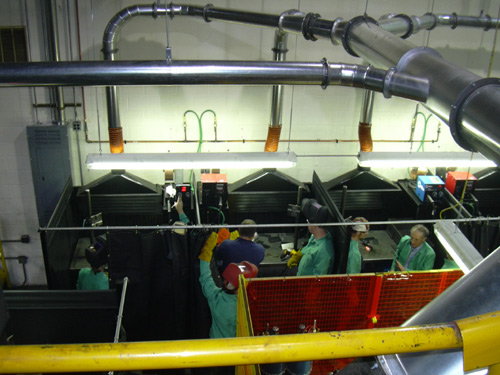
The following weld comparisons were made
using a low cost MIG power source, the Lincoln CV 300, (the Lincoln CV 400 provides
the same results and can be interfaced with a robot). The Lincoln CV 300 costs
approx. $2000 and the CV 400 would cost approx. $3000.
Compare what you pay for your robot weld equipment. In 2004, the CV 400 robot
MIG package, including wire feed and interface, would sell for approx. $6500.
For those tier one companies who get a thirty percent discount on the weld equipment
they purchase, did you pay more than $4500 for your
robot weld package, (power source and interface). Every penny you spent over this
price was a penny thrown out of your window.
The
Lincoln CV 400 will outperform the Lincoln pulsed Power Wave 455 and any of the
Miller, ESAB or Japanese pulsed equipment on carbon steel weld. In contrast to
the low cost CV equipment, the Lincoln Power Wave unit including a wire feeder
and interface will retail for around $12000 to $14000. In
this segment the Lincoln CV welds are also compared with the Lincoln Invertec,
an inverter pulsed power source which sells for approx. thirty percent more than
the CV 400.
Lincoln
CV 300 or 400: Ed made this untouched "manual",
5/16, 8 mm fillet
weld at 450 ipm, approx. 13 lb/hr 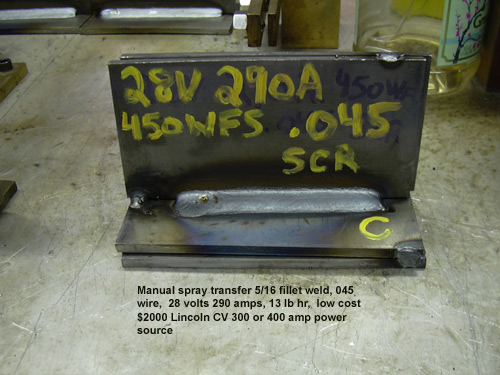
Note
with this untouched fillet weld sample, no weld spatter, and the "flat"
smooth weld surface.
Also note the weld's straight edges which indicate consistent
weld transfer and consistent weld fusion.
PICTURE
ABOVE: With an 0.045, (1.2 mm), E70S-3 MIG wire and argon
- 10% CO2 gas mix, Ed ran the 0.045 wire at a wire feed rate of 450 ipm. The 450
ipm is an optimum spray transfer wire feed rate for many auto / truck frame manufactures,
robot welding carbon steel parts 2.5 to 6 mm. The 450 ipm wire feed rate will
enable a 4 to 5 mm fillet weld at a robot travel rate of 40 to 50 ipm. This rate
will also produce a 1/4, (6 mm) fillet weld at a robot speed of 20 to 22 ipm.
Pulsed
versus Spray. 0.045 (1.2mm) steel wire set at 350 ipm. 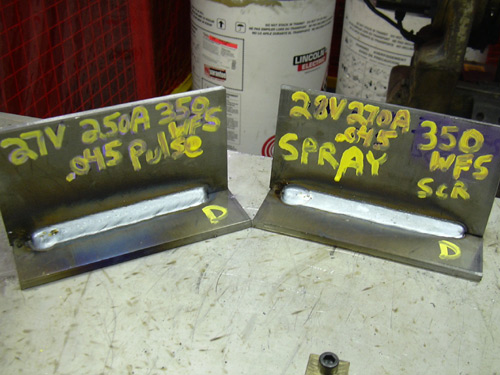
Picture
above. The pulsed weld on left sample made with the 0.045
wire, versus the weld on the right made with with the same wire size and wire
feed rate using conventional CV spray. Both welds were made with the wire feed
set at 350 ipm delivering approx. 9 - 10 lb/hr. When set at 350 ipm, the 0.045
wire is in an "optimum" pulsed wire feed setting. The 0.045 wire set
at 350 ipm is also the approx. "start point" of spray transfer weld.
Again note the pulsed weld inconsistency is clearly evident in the convex surface
and inconsistent weld edges. When sectioned, you know which of these two welds
provided superior weld fusion.
If you want robot weld stability at high
weld deposition rates, purchase a CV power source and pay approx. $6000 rather
than waste $12000 on pulsed MIG equipment. If you have already spent your dollars
on that pulsed power source and want to improve weld fusion or arc stability switch
over to spray transfer.
Pulsed
versus Spray. 0.045 (1.2mm) steel wire set at 450 ipm. 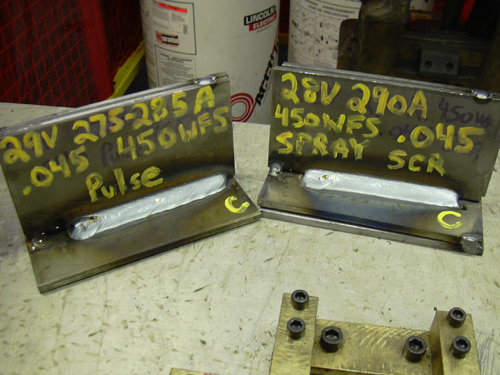
Picture Above: Again you don't
have to be a weld expert to that when the 0.045 wire is set at 450 ipm, (approx.
13 lb/hr), which weld is optimum. The 0.045 wire set at 450 ipm is used on many
robot spray welds on parts >5 mm. This one picture tells you why auto industry
executives and engineers have wasted millions of dollars on paying an expensive
premium for electronic pulsed equipment that has not created any steel weld benefits
for their plants
.
Pulsed
versus Spray. 0.045 (1.2mm) steel wire set at 550 ipm.
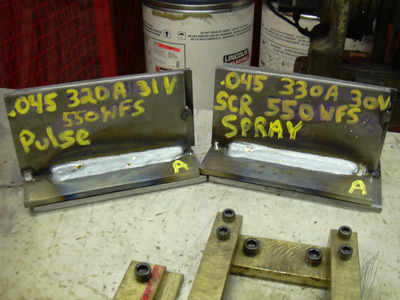
PICTURE ABOVE: Of course if you want the maximum
possible MIG weld deposition rate or highest ROBOT weld speeds from the robots
on steel parts > 8 mm you will use an 0.045 wire set around 550 ipm, 15 to
16 lb /hr. This is a common spray wire feed setting you don't want to set with
that costly pulsed power source. One thing you can say for the pulsed process,
at low or high wire feed rates the weld inconsistency is consistent.
IT'S
ALSO TRUE WITH 0.035 (1mm) WIRES.
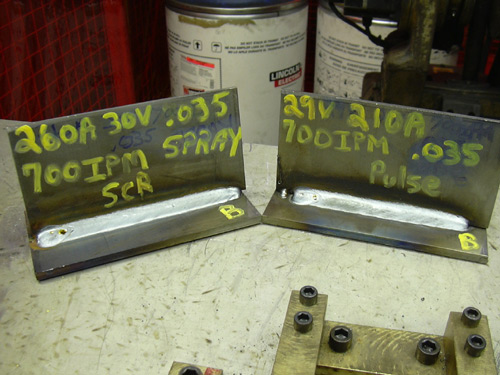
PICTURE ABOVE: With the 0.035 wire and argon 10% - CO2. Ed opened the wire feed
control to it's maximum setting and provided a wire feed rate of 700 ipm. Again
look at the spray weld on the left versus the pulsed weld on the right. The pulsed
weld with the 0.035 wire indicated the same inconsistent weld transfer pattern
as with the 0.045 wire. The pulsed weld was again more convex and the side wall
weld fusion was again less inconsistent than the spray weld. Again note both welds
are untouched with no spatter.
0.035
SET AT AN OPTIMUM MID RANGE PULSED WIRE FEED RATE OF 550 ipm
you know which
is the best weld. 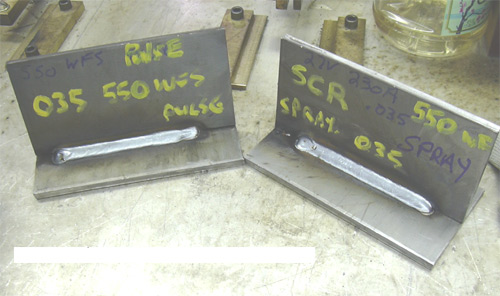
Picture Above. Again note the 0035 wire comparison of the pulsed mode versus
spray transfer weld. In the pulsed picture on the right, the welds are made at
a mid range wire feed setting of 550 ipm. As the weld indicates again the traditional
spray mode shows more consistency in the metal flow rate.
If
you want up-todate, unbiased, Pulsed MIG versus lower cost traditional CV MIG
equipment data, don't ask a salesman, visit the world's largest website, www.weldreality.com.
If
you want the most effective robot and manual MIG and flux cored weld process control
training program, visit here.. | |