 |
 At www.tiptigusa.com, you will find a weld process that always produces superior weld quality than TIG, and is 100 to 500% faster. |
MIG and flux cored ship building and oil platform weld issues with rapid weld management weld resolutions.
Welcome to the world's largest web site on MIG, Flux Cored, Advanced TIG and TIP TIG, Weld Process Controls & Best Weld Practices.
This web site was first established in 1997 by Ed Craig. Contact Ed. ecraig@weldreality.com
Each year according to the International Association of Independent Tanker owners, known as Intertanko, from 1990 to 2000, an average of 400 tankers break apart at sea or barely escaped that fate. The leading cause was collision, but nearly as many suffered from “Unknown Structural (weld failures) or technical problems.
Ship building. MIG and Flux Cored Weld Issues Weld Resolutions.
The Canadian yard managers & engineers and supervisors were not aware that their yard was in a state of Weld Process Chaos:
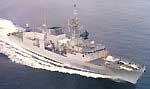
During the nineteen nineties, I was invited to provide a weld evaluation for a Canadian Ship Yard that was building Frigates for the Canadian Navy. The weld engineers and management at the ship yard had allowed the use of poor weld practices and did not appear to understand the concepts of MIG or FCAW process controls or even understand the fundamentals of theses two important weld processes that were utilized for most of the welds on the Navy Frigates. I also found it interesting that the management that lacked the requirements for Weld Process Ownership,did not allow the weld engineers that were employed in the yard to tell the welders what to do. The bottom line was the ship yard weld quality and productivity was run by the yard welders, and the majority of these welders lacked an understanding of the MIG and flux cored processes utilized. Lets first examine ship yard weld costs.
Few managers and supervisore in ship yards are aware of what welders should be depositing each shift.
When you weld a 1/4 (6mm) horizontal fillet weld with MIG or flux cored wire, you provide a "single pass weld" with either a MIG Spray weld, or a flux cored wire using a high wire feed - volt setting. Both of these weld processes would provide a typical weld deposition range of approx. 9 to 12 lb/hr.
WHAT WELDERS SHOULD BE DEPOSITING EACH SHIFT...In any ship yard, when welding fillets, multipass fillets or groove welds, (good groove welds use 1.4 fillet wire feed settings), and with a 20 minute hourly arc on time, welder who is well managed, would deposit on average 20 to 24 pounds of MIG or flux cored weld wire per shift.
Note. You will find that most ship yard welders average 8 to 15 lbs of wire per-eight hr. shift. Extensive simplified weld data availabthis
If you understand process controls weld costs are easy.
WHATSTHE MIG or FLUX CORED DAILY WELD PRODUCTION EFFICIENCY AT THE AVERAGE SHIP YARD?
An acceptable average MIG and Flux Cored weld wire usage per eight shift day for weld shops welding parts > 4 mm should be 20 pounds of weld wire per-shift. A highly effiicient weld shop would be depositing > 24 pounds per-shift. Those shops that weld thinner parts < 4 mm, should be depositing on average between 8 - 10 pounds per shift.
To compete in a global weld market in which the Chinese are now welding bridges for the state of California, management should have the capability to understand both the weld quality requirements and the weld deposition rate potential per welder. In a large weld shop where welders weld and someone else does the fitting on parts > 4 mm, if you multiply the total welder man hours by 3, you will see how many pounds of MIG or flux cored weld wire should be deposited daily. Then call the purchasing manager, ask them to let you know how much wire was purchased and used in the previous year. With this information you will quickly get a grasp of where you are from a weld reference the weld you are depositing and your real weld production potential.
Note: Most of the large MIG - flux cored weld projects that I visited in 13 countries were only achieving 40 - 60% of the welds that they should have been daily deposited. To be aware of how to attain the weld production goals and train the weld personnel on how to achieve these weld production goals, please visit my MIG and Flux Cored Process Control training resources
Note: Single pass welds are fine with horizontal fillet welds up to 5/16 (8mm). When the horizontal fillet weld size required is larger than 5/16, the weld shop would have concern for side wall fusion and the solution is to weld the large fillets using 1/4 (6mm) multi-pass stringers.
Note if you are looking for the best weld quality, do not allow manual welders to use weaves for any position pass fillet or groove welds above 5/16 as lack of fusion may occur and excess weld heat (weaker HAZ - distortion ) will be generated.
Note Weave allowed for root and caps only.
I dont believe that there is one global ship yard that has taught their weld personnel the weld process controls and best weld practices required for weld process optimization.
A COMPLETE LACK OF WELD PROCESS CONTROL EXPERTISE WAS EVIDENT IN MINUTES: In the Canadian ship yard, the two prime weld processes that were daily utilized on the majority of the welds were using INCORRECT WELD PARAMETERS & INCORRECT WELL PRACTICES. For example to make the 1/4, (6.4mm) carbon steel, horizontal fillet welds on the Navy Frigates, the welders would typically apply TWO WELDS that were carried out with TWO DIFFERENT WELD PROCESSES, MIG and Gas Shielded Flux Cored.
At the Canadian yard, to make a simple horizontal, steel 1/4 fillet weld ON > 1/4 steel parts, the welders would first make a COLD, MIG "Short Circuit, close to globular weld" that provided a deposition rate of 6 lb/hr. This cold weld was better suited to welding thin gauge 0.080 (1.8 mm) sheet metal parts. This first weld pass had to result in Frigate welds that had extensive lack of weld fusion. To finish the 1/4 fillet welds, the welders would do something which revealed the complete lack of weld control in this Canadian Navy yard. For the second weld pass on top of the MIG, cold short circuit weld, for some crazy illogical reason, the welders had been told to change their weld process to Gas Shielded Flux Cored. With their flux cored wire, the welders would use the same wire feed and voltage that they had used with the MIG wire, these guys had just ued one incorrect setting for any weld or any process). T
The low flux cored wire feed and volt settings used by the welders ensured that the ship yard welders were placing a COLD flux cored weld over the top of the COLD MIG short circuit - glob weld..
IF THE MANAGERS, ENGINEERS AND SUPERVISORS WERE NOT MANAGING THE WELD PROCESSES, WHO WAS?
SOMEONE FORGOT TO TELL THE CANADIAN NAVY PERSONNEL AND SHIP BUILDING MANAGEMENT, "THAT WHEN THEIR WELDERS USE INCORRECT, COLD WELD PARAMETERS, THAT THEY WILL END UP WITH A COSTLY LACK OF FUSION AND EXTENSIVE WELD POROSITY WELD DEFECTS. THEY WILL END UP WITH EXTENSIVE WELD REWORK AND THE POTENTIAL FOR STRUCTURAL WELD FAILURES.
The great majority of the two pass fillet welds made on the Canadian Frigates would reveal extensive lack of weld fusion and weld porosity. Also the cold flux cored weld settings when used on most of the ships welds would result also in extensive lack of fusion and slag entrapment.
Each day at this ship yard using inappropriate weld settings and weld practices, the 200 to 300 ship yard welders would have produced thousands of feet of single & multiipass welds on the Navy frigate. It should come as no surprise to those reading this, that as I walked around the yard and talked to the key weld decision makers and to the welders, I did not manage to talk to anyone who knew what MIG Short Circuit, Globular or Spray Transfer was, and even fewer understood the optimum working parameter range and best weld practices that was required for the E71T-1 flux cored wires..
Note: The majority of the Canadian Frigate MIG and Flux Cored welds only required visual surface examination, so lack of weld fusion and internal weld defects were not revealed.
BACK TO WELD COSTS: THE AVERAGE WELD DEPOSITION RATE AT THE CANADIAN YARD WAS 5 LB/HR. WITH A 20 MIN ARC ON TIME THATS ABOUT 1.4 LB/HR OR 11 LB IN AN 8 HOUR SHIFT AND FOR THAT CANADIAN SHIP YARD THATS ABOUT 50% LESS METAL THAN A WELL RUN WELD SHOP WOULD DEPOSIT.
The MIG short circuit (SC) - globular parameters that were used with the 0.045 (1.2mm) wires were set at the SC typical wire feed rate of 210 to 280 ipm, (average approx. 5 - 7 lb/hr) with 180 to 230 amps and 19 to 22 volts, (20 plus volts promotes glob and excess spatter).. Without question, the majority of these welds would result in extensive lack of weld fusion, and other internal defects on any carbon steel parts > 4 mm. The flux cored data that also use these settings was better suited to a poor quality low setting "vertical up weld," The average flux cored weld deposition would have been 4 - 6 lb/hr.
Ed's - Em's MIG Spray, Single Pass fillet. 045 wire. 450 ipm - 28 volts. 12 lb/hr
COSTS: THE AVERAGE DEPOSITION RATE AT A WELL RUN WELD SHOP THAT WELDS THE SAME PARTS WOULD BE 9 - 12 LB/HR.
For those few mgrs, engineers or supervisors . that have an interest with weld process control and cost info. To make a single pass, horizontal,1/4 fillet with the 0.045 flux cored wire, you would typically set approx. 500 inch/min, (average 9 - 10 lb/hr) with 27 - 28 volts. For the MIG process a wire feed rate of approx. 420 - 450 inch/min, (average 11 - 12 lb/hr).
Every global ship yard has a great opportunity for weld quality improvements and weld cost reductions. This was applicable in 1960 and it will be applicable in 2020.
Its possible that aby Navy's worst enemy may be the welds on its ships..
.
.
IF MANAGEMENT, ENGINEERS & SUPERVISION DO NOT FULLY UNDERSTAND "WELD PROCESS CONTROLS AND WELD COSTS", THESE SUBJECT ARE NOT LIKELY LIKELY TO BE PART OF THEIR THE DAY TO DAY WELD SHOP CONVERSATIONS:
To put salt in the Canadian Frigates ship yard management wounds, every weld produced with the low wire feed (low deposition rate) settings, took each of the 250 - 300 welders approx. 200% longer than it should have.
This Canadian yard ironically spent over a million dollars annually on "welder training" which resulted in extraordinary poor weld productivity and quality. I estimated that the low weld deposition rates and unnecessary weld rework would readily result in over 15 to 20 MILLION dollars per year on unnecessary weld labor and rework costs. I delivered my weld report to the yard management. The report provided waht the issues were and the required data and practices for the yard to get it's welds to the quality and productivity that they could readidly attain.
I was later informed that my weld report never got as far as the first manager who reviewed it. The report then disappeared into the nearest garbage container. I was later told by the key weld suppler to the yard that the manager was too embarrassed to present the report to his executive team, and also he did not want the Canadian Navy Brass to be aware of the weld quality produced and the unnecessary yard over weld costs.
ALL WELD DECISION MAKERS HAVE A RESPONSIBILITY TO THEIR ORGANIZATION TO LEARN AND FOCUS ON THE REQUIRED BEST WELD PRACTICES - WELD PROCESS CONROL EXPERTISE. USING MY SELF TEACHING - TRAINING RESOURCES,
From Canada to the USA, the ship yards have much in common.
INTHIS USA SHIP YARD, I PROVIDED MY WELD PROCESS CONTROLS - BEST WELD PRACTICE TRAINING PROGRAN WHICH IN A FEW MONTHS REDUCED THE OIL TANKER / CONTAINER CONSTRUCTION WELD REPAIR COSTS BY APPROX. 60%.
In building a fleet of oil tankers / container ship at the Navy Yard in Philadelphia, this global ship building company had budgeted a few hundred thousand dollars per-ship for its projected ship weld repairs. In 2007, when I was called in to help the yard with it's weld quality and productivity problemsm at this time, the yard's mostly flux cored weld repair costs per vessel was between eight and ten million dollars.
The prime manual weld process used at this USA ship yard, was the Gas Shielded Flux Cored weld process. Most of the 300 welders in the yard used E71T-1 (1.2 mm) flux cored wires to weld all position, Vee Groove, 9 to 25mm, steel joints that used ceramic backing for the open root welds. Like many ship yards, the Aker management, engineers and QA personnel knew little about either the flux cored and MIG processes, their experience was usually with the SMAW (STICK WELD) process, a process in which welder skills is the prime requirement and minimal weld process control expertise is requied.In this yard, as it is with many large scale weld projects, the flux cored welder training focus was on the "welder's skills", and the skills taught had more to do with the practices used with the SMAW process. The skills taught in the yards training facility were not the optimum best practices required for all position flux cored welds and ceramic backing. As also is common in most ship yards, the training provided no best no weld process controls, so the welders do what many have done for decades, "played around" with their weld controls..
To work at this US ship yard, the welders had to pass an ABS all position, flux cored weld tests with ceramic backed vee groove welds, (6 mm root gaps) The welds were to be made in accordance with the yards weld specs / procedures.
OFTEN, "WELD QUALIFICATION TESTS" ARE IRRELEVANT AS THEY WILL HAVE LITTLE IN COMMON WITH THE WELDS MADE ON THE ACTUAL WELD APPLICATIONS.
This ship yard was managed by managers - engineers and supervisors who while comfortable around a box of stick electrodes, lacked the awareness - expertise of the unique requirements necessary to attain consistent, optimum manual or automated flux cored weld quality for those ceramic backed steel groove welds. In the last five decades, the lack of valuable weld process control - best practice expertise appears to be common with weld decision makers on large scale weld projects, and it should not take a rocket scientist to figure out the future weld liability and the weld cost consequences.
THE EXTRAORDINARY OVER BUDGET USA SHIP YARD WELD REWORK COSTS, WOULD NOT CHANGE TILL I INSISTED THAT ALL THOSE INVOLVED, INCLUDING THE FRONT OFFICE PERSONNEL ATTEND MY PROCESS CONTROL TRAINING SO THEY COULD ALL WALK THE SAME PATH TO WELD PROCESS OPTIMIZATION.
For the Flux Cored Weld Best Practices - Process Control Training Program that I was to present, I insisted that not only the welders, but also the repposible supervisors, engineers, managers and QA personnel in the yard participate in my unique training program.
Note for ship yard bean counters, this weld process training program does not require weeks, months or years it requires approx. eight hours, "four hours classroom and four hours hands on".
With my best friend Tom O'Malley assisting, (Tom in light blue jkt on right died in Feb. 2015). RIP TOM always will love your spirit and freindship and keep your eye on me. In a few weeks Tom and I completd the training for approx. 300 welders and for the yards newly eductated weld decision makers.
THE SHIP YARD WELD SAVINGS RESULTS WERE PROVIDED: After my training was complete, the senior ship yard managemnent made the ship yard QA department manger responsible to evaluate the weld cost saving results through the weekly reductions with the ship's weld rework. Three to four months after the training, the ship yard QA department indicated a 50 to 60% reduction in the required weld rework per-ship. As the weld rework was still decreasing, further cost reductions were projected and dont forget I have not discussed the 30% Increased weld productivity that was attained from the welders using the correct (higher) wire feed settings.
Ed's MIG and flux cored self teaching or training programs are available at this site
HOW MANY MORE DECADES WILL WE REQUIRE FOR MANAGERS AND TRAINERS TO REALIZE THAT SMAW HAS NOTHING IN COMMON WITH MIG OR FLUX CORED?
It's not unusual for weld personnel to have many weeks of flux cored hands on training at global ship yards, and then after the training completion, find that when it comes to MIG and flux cored welds, the weld personnel will do the following;
[a] PLAY AROUND: Many welders will play around with two simple MIG or flux cored weld controls that have not changed in sixty years, The welders and their supervisors will rarely be able to dial in the optimum flux cored weld settings for the Vee groove root, hot pass, fill pass and cap passes. And don't ask that welder to tell you the optimum MIG settings for that common horizontal 1/4 fillet weld.
[b] NOT BE AWARE OF PROCESS CONTROLS AND LIMIT THEIR WELD ADJUSTMENTS: Instead of optimizing the welds through the MIG weld equipment controls, many welders will typically find one weld setting and if they cant find one, the welder may copy the settings of another welder although that welder is doing a very different weld. A welder should be able to make optimum weld parameter changes that suit the conditions they have to deal with. Imagine how annoyed a machine shop supervisor would be, if his lath and milling machine operators used one control setting for every different job they were given.
[c] NOT BE AWARE OF THE BEST WELD PRACTICES? As they have rarely received best practice training, it should be no surprise that most MIG and flux cored welders will not utilize the optimum weld practices - techniques required for either the MIG or flux cored process.
[d] NOT BE AWARE OF THEIR INFLUENCE ON WELD COSTS? Lack of management, engineer, supervisor and welder awareness of the wire feed to weld deposition relationship and the weld deposition rate potential for the common flux cored or MIG welds certainly makes it difficult to be competitive and to control weld costs.
A BREAK DOWN OF THE WELD COST SAVINGS GENERATED FOR THE USA SHIP YARD:
Examine the following ship yard weld cost reduction and the weld benefits attained from my unique process control training program. Many mangers may not be keen on training as in the past the weld training did not improve the weld quality or productivity. (Managers, if you dont provide the right training you don't get the best results).
Training weld personnel is costly, and the larger the weld shop the greater the training costs. With this in mind it should be no surprise to find some one in management that may be worried about the production man hours lost when training is required for their employees.
Weld Best Practices - Process Control Training Costs:
The Acker flux cored welder training program I produced, required 300 x 8 man/hrs. = 2400 man hours at an approx. weld labor overhead cost of $30/hr. The base labour training cost for the ship yard training was $72,000. To this add the actual training and material costs which was approx. $100,000. Total training costs for the 300 welders was approx. $172,000.
Shipi Yard Weld Rework Cost Reduction Savings Per-Ship:
The initial weld improvement results revealed an instant savings of six million dollars. With management - engineering and supervision focus on maintaining the skills - process control expertise required, the reduction in weld rework costs will continue and could easily reach 7 to 8 million dollars on each tanker or container vessel produced.
Ship Yard Weld Cost Reduction from Increased Weld Productivity:An unreported weld cost fact from the Aker yard was the changes that I created in the development of the new weld procedures. My weld procedures generated a dramatic increase in the gas shielded flux cored wire feed rates, (increasing the weld deposition rates). The new weld procedures increased the daily weld productivity potential per-man in the range from 30 to 35%. If the managers and supervisors kept their focus on weld deposition potential, it would be easy for the yard to attain a weld labor cost reduction per ship of between four and five million dollars.
Ship Yard Weld Cost Reductions from welding the Correct Size Weld Joints:
If this ship yard manufacturing management, engineers, supervisors and fitters, decided to provide the weld joints in accoradance with the actual design dimensions and tolerances, it would be easy to reduce the weld labor and rework by another 1 to 2 million dollars per-ship.
Ship Yard Management - Ownership - Responsibility - Accountability.
Note I took > 3000 hours to develop both the Flux Cored - MIG training programs available at this site. My unique Weld Control Clock Method simplifies the training or self teaching. This is a method I developed over three decades and the programs can be used for any MIG or gas shielded flux cored alloys or applications. Programs available here
My thanks to the Aker Kvaerner management who first resisting the required weld changes rhowever out of budget desperation they finally allowed me to provide the process control welding changes that made them look like they knew what they were doing.
1945 0R 2015, hopefully one day they will get it right.
In the good old STICK (SMAW) weld days which for some projects is still ongoing, some steel ships broke apart at the welds before they left the dry dock. These and the catastrophic structural failures that occurred at sea, were often a result of low hydrogen cracking, poor weld practices, steels with poor chemistry, (high impurities) and design ignorance of plate - weld mechanical properties and the influence of cold temperatures.
Since the 1980's the majority of ships have been built from high quality, low carbon steels and welded with low hydrogen SMAW - MIG and flux cored consumables. You would have thought these two important attributes would have resolved the catastrophic ship failure issues that have occured since 2008. Lets face it, welds on low carbon steels, are typically supposed to surpass the strength and ductility of the base steels, and if the welds are applied correctly, the welds and surrounding base metals are not supposed to fail.
The weld reality is however different, while many ships and oil platforms have plate and pipe that will be affected by rust, during unforeseen circumstances or severe weather while the steel parts impregnated with rust stay intact, the welds and weld heat affected zones will tear apart like a wet paper bag.
03/ 2007:Of course its possible that the global ship building management lack of best weld practices and lack of weld process controls expertise is partially responsible for many of the catastrophic failures that sink all types of ships each year?
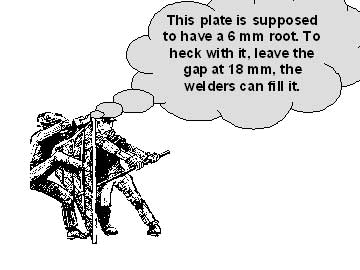
ABOVE, A COMMON SHIP YARD FABRICATION ATTITUDE, TOO OFTEN CREATES OVER SIZE WELDS AND OVERSIZE WELD HAZ.
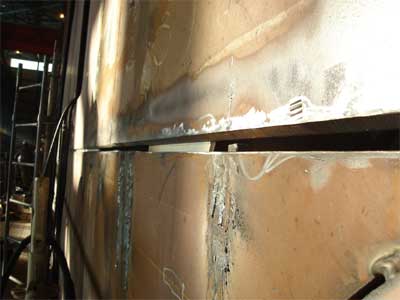
THE USA SHIP YARD HAD EUROPEAN, HIGHLY QUALIFIED SHIP BUILDING MANAGEMENT AND ENGINEERS, AND A LARGE QA DEPARTMENT, YET THEY ALLOWED WELD JOINTS LIKE THIS..
It's a weld reality that the QA departments in many ship yards and oil platform yards, while looking for weld defects the QA department personnel will place minimal focus on the design fit tolerances and the quality standards that are supposed to be applied to the part fit and weld edge preparations. Its also a fact that pre-heat and interpass weld temperatures are often not utilized when they could provide good weld / part benefits.
The picture on the left is a flux cored weld edge prep (made in 2007) at a major USA ship yard. Yes the gap opening is larger than one inch and that is ice and water surrounding the weld joint. On this joint there was no weld preheat applied and no interpass weld temperatures applied during the numerous welds. To add to this pathetic weld situation, the mill scale was left on the groove edges and cutting oxides were left on the groove surfaces. Weld joints like this shoud never be allowed especially in these industries.
DOES A STEEL BACKED, 6 mm ROOT GAP ON SHIPS PLATE, PROVIDE THE SAME HAZ MECHANICAL PROPERTIES, WHEN THAT ROOT GAP IS ALLOWED TO INCREASE IN THE RANGE OF 8 TO 25 mm.?
WITH THE EXTRA WELD PASSES FROM THE OVER SIZED ROOT WELDS, THE RESULTING , INCREASED WELD HEAT AND INCREASED WELD DEFECTS WILL HAVE DRAMATIC NEGATIVE RESULTS FOR BOTH THE WELD AND WELD JOINT MECHANICAL PROPERTIES. WITH THIS IN MIND, YOU WOULD EXPECT THE SHIP YARD ENGINEERS TO PROVIDE STRICTER SHIP YARD MAX. WELD DIMESION REQUIREMENTS AND ENSURE THE CORRECT FABRICATION AND WELD CONTROLS ARE APPLIED.
Weld - steel qualification tests for critcal ship weld plate joints are typically taken from optimum weld joints with specified max root gap openings. It would be of interest, if the navy and ship building industry, both of which will often turn a blind eye or enable welds that allow extensive oversize root tolerances, to provide the necessay research to find out the following;
[a] what the negative weld heat influence will be from the numerous extra weld passes.
[b] what the negative consequences will be from the combinations of the extra weld defect buildup and extra weld heat would be on the mechanical properties,
[c] what is the real world maximum root gap cut off point before the mechanical properties will be outside those specified by the ship's designers? After this research, I would anticipate a dramatic reduction in the open root tolerances, more focus on interpass temperature controls and and stricter part fit controls in the fab shops.
The additional HAZ weld heat provides many questions about the mechanical properties being achieved with many weld joints. Every time I see photos of ships that unexpectantly tear apart at sea, and you see that nice clean straight tear where the welds HAZ is located I think about these weld situations.
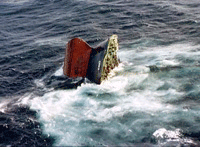
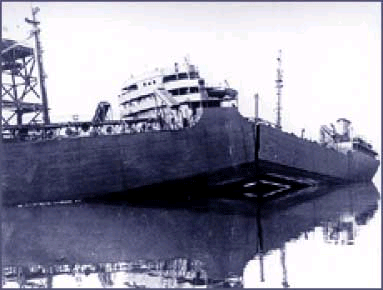
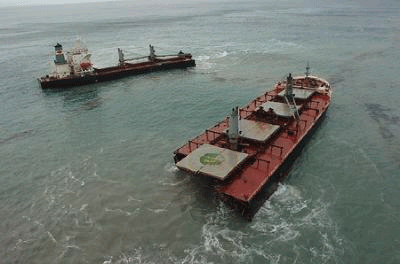
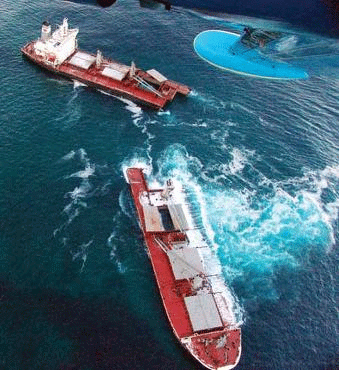
Quick, before it sinks. Examine how nice and clean the catastrophic failure tears are, right down those weld seams and their weld HAZ..
There is only one weld standard and it should apply to all ship welds.
2007: With all ship welds, we need more focus on the weld quality not subject to internal weld evaluation and also on the steel mechanical properties being attained especially with oversize weld's HAZ.
2007: It's a weld reality that in ship yards and on other mega oil and natural gas projects, that many unacceptable variables will happen to the weld joints and welds and those "variables that impact the welds are typically not considered in the pre-qualification welder procedures generated".
When the weld personnel are not supplied with the process control training necessary to deal with the weld shop variables, the welders will typically play with the weld controls and not provide optimum weld settings to deal with the weld situations.
Weld Quality Standards will have a different meaning for each company that builds ships or oil platforms. One thing most QA departments will have in common, is their weld quality focus will be on "finding rather than preventing weld defects".
I often wonder if we have learnt anything about arc welding ships in the last six decades?
29/07 Note from Ed:
Designers and metallurgists will typically look to the ship's design, steel - alloy compositions, environment, water temp, weather and the formation of rust for the causes of many catastrophic ship failures. I wonder how many designers will take into account that on any global built ship the NDT that examines the internal weld quality is only applied to a small percentage of the ships welds.
IRRESPECTIVE OF THE WELD CODES UTILIZED, COMMON SENSE WOULD ENSURE THAT ENGINEERS CREATE PRE- QUALIFICATION WELD TESTS THAT ALLOW FOR THE REAL WORLD "WORSE CASE WELD SITUATIONS & VARIABLES THAT ARE LIKELY TO TAKE PLACE WITH THE INTENDED WELD APPLICATIONS".
Poor Welds and Lawers Love the Liability Consequences.
Dam, it broke apart right along the weld seams, and that was not much of a storm.
Many ship yards forget that oversized weld joints require many more weld passes producing extra weld heat (larger HAZ) and more internal weld defects. An increase in weld defects with a weaker plate HAZ is not a combination any organization should accept.
While the ABS code, Navy or any ship builder will stipulate a maximum root gap allowance in most instances its rarely adhered to. The weld reality is weld and material metallurgical weld qualification tests should always be carried out with the maximum allowable root gaps and those root gap dimensions must have strict min and max tolerances that must be followed. Unfortunately as the photo on the left indicates this is the real world weld joints that are rarely shown in the engineers office.
When building merchant or naval vessesls, the too common poor control of the weld joint will often leave edge preps that have irregular, oxide and scale laden surfaces. The edge preps may also not have the required pre-heat on those cold or wet days. The wet plates or cold plates, lack of pre-heat combined, oxides - scale and frequent lack of interpass controls with innapropriate weld parameters, techniques and practices, and the usual lack of care of the consumables leads to extensive lack of weld fusion, weld slag inclusions, porosity and lower than required plate / weld mechanical properties..
As only a small portion of a ship's welds are typically subject to NDT, both the navy and merchant navy would do well to put a renewed focus on weld process control training that is directed at weld defect prevention and good weld practices. All managers need to be aware that it's just as easy to produce optimum quality welds as it is to produce poor welds.
The following are a sample of recent news paper or web reports on typical weld and related issues that have occured in ship yards. It's true that with large scale weld fabrications it should be no surprise that they are extensive weld issues. It just seems strange that few managers today seem to want to take opportunity to take ownership ot their processes and control of the many variables that can provide dramatic weld cost reductions for their organizations.
As reported by the Navy, on this vessel only one weld out of approximately 100 tested passed the NDT requirements.
Was the ship's or the Oil platforms demise from a freak of nature, or from the poor flux cored or MIG welds?
MOST DESIGNERS ASSUME THAT THE SHIPS OR OIL PLATFORMS THAT THEY DESIGN, WILL BE BUILT IN ACCORDANCE WITH THE DESIGN WELD SPECIFICATIONS PROVIDED. THE WELD REALITY IN SHIP BUILDING IS THAT FEW ARE.
LETS FACE IT'S DIFFICULT TO TEST AND CONFIRM THE OVERALL WELD INTEGRITY ONCE THE SHIP YARD OR OIL PLATFORM IS SITTING ON THE OCEAN FLOOR.The sad reality in 2020. is the amount and type of weld defects typically found in a ship's construction, will have has hardly changed from the weld defects found six decades ago.
In the 1940's, poor quality stick (SMAW) welds were the norm. The weld quality was further influenced by electrode issues (hydrogen and quality concerns) combined with poor quality rivets and steels, and of course the lack of optimum SMAW weld practices that when combined resulted in numerous Liberty ships that suffered from catastrophic weld & steel failures.
Seventy plus years later, in general (there are of course exceptions) in the weld industry we have achieved what.? Today in 2019 we have a superior flux cored wires for all position ship plate - pipe welds. We also have the MIG process and good automated weld equipment. We weld on far superior quality steels and alloys. However due to the global lack of management / engineering weld process control expertise and lack of best weld practices, too many of the "we take no ownership" ship and oil platform weld management and their supervision still take weld advice from salesmen, allow weld personnel to "play around" with weld controls, accept welds that are riddled with costly weld defects, and lack the understanding of the weld process weld production rate potential.
<1960: 5000 liberty ships built, 1000 catastrophic
failures most right down the weld seams.
Decades later,oil platforms and ships for some strange reason sinking before their time.
For those looking for the structural security attained from the double hull construction that will occur when building large ships or more costly ships, keep in mind that unless ship yards change their approach to weld best practices and process controls, the double hull ships may simply enable double the amount of bad welds.
HOW RELEVANT IS THE SHIP'S DESIGN, WHEN MANY OF THE WELDS ON THE SHIP WONT MEET THE DESIGN WELD SPECIFICATION REQUIREMENTS?
2006: Each week one or two global ships sink, many as a result of weakened
structures from corrosion. Rarely does anyone ask how many ships sink annualy as a result of bad weld practices, and why do ships appear to get torn apart in calm waters down the weld seams?
From my perspective I always avoid the use of Chinease, Eastern Europe or S. American weld consumables
A note from E Craig. 03/2007:
A ship yard may use half to a million pounds of flux cored weld wire each year, however it's rare to find a ship yard that has management and engineers who have established Best Flux Cored Weld Practices and implemented effective Weld Process Control Training for their weld personnel.
How many ship yard managers and supervisors are aware of the following?
For decades the global shipyard focus has been on the welder's "stick welding skills while the majority of global ship yard welders that weld with the flux cored - MIG process, lack weld best practices - process control and consumable expertise.
Too many weld personnel in ship yards will daily use the unsuitable weld techniques and skills that they learnt with the lower weld energy, lower weld deposition stick welding process.
With the flux cored process, the variable size root gaps and the placement of weld across none conductive ceramic backing requires unique weld considerations and specific instructions for the all position, root, fill and cap weld passes. A visit to any global ship yard, would reveal that few welders, supervisors or "engineers" are aware of the flux cored process and ceramic requirements necessary for consistent weld optimisation.
2008: It's a sad comment in a time when MIG and flux cored weld defects inundate ships and oil platform construction, that at many global ship yards, weld apprentices will spend more time practicing with stick electrodes than they will with MIG and flux cored consumables. It's also a weld reality that many weld instructors when providing MIG and flux cored training, will teach the apprentices inappropriate stick welding practices and techniques. You dont want to ask any weld instructor in a ship yard this fundamental MIG question. " What is the wire feed and current start point of spray transfer with the world's most common 0.045, E70S-6 MIG wire and argon - 20% CO2"..
YOU CANNOT CONTROL THE WELD QUALITY - PRODUCTIVITY AND COSTS IF YOU CANNOT CONTROL THE PROCESS.
Try the following fundamental weld process questions.
[] Fundamental MIG Process Control Weld Test
[] Fundamental Flux Cored Process Control Weld Test.[] Ed's Unique, MIG and Flux Cored Weld Process Control Training Resources
It looks like someone needs help with the ship fabrication and the welds.
Accountability - Responsibility - Ownership....36 million in repairs and 400 million
over budget & the seniior management and engineers are still on the job.The above Navy vessel failed to complete a series of sea trials and required $36 million in repairs. The ship was been plagued by mechanical and structural problems since the Navy took ownership and it was also two years late. The ship was built at a cost of $1.2 billion and was, roughly $400 million over budget.
IF I WAS MANAGING A SHIP YARD IN THE 21st CENTURY, APART FROM CHANGING THE TRAINING DEPARTMENT AND THE WAY THE WELDERS TAKE THEIR WELDER QUALIFICATION TEST I WOULD ALSO LIKELY CHANGE THE THE QA DEPARTMENT OPERATES.
For decades, on many mega weld projects, a typical QA / CWI primary function has been to "find fault after the weld completion". With minimal cost, managers or engineers could provide my Weld Process Control - Best Weld Practice Training Program for the weld inspection personnel so they learn the requirements necessay to prevent the MIG or flux cored weld defects.
The reduction in weld defects, less weld rework and much lower NDT costs, would have a big impact on any companies bottom line.
If the guys in the front office don't fully understand weld costs, who is going to understand the requirements necessary to attain optimum quality welds at the lowest possible cost?.
There are ten individuals comprising of managers, engineers and supervisors having a weld meeting in the ship yard managers office. The meeting was called to discuss the reasons for the increasing weld costs associated with the weld rework. Most of the welds are made on fabricated components that require simple 1/4 flux cored fillet welds. The weld procedure is passed around the table with information on the consumable type and size, the wire feed rate and the volts being utilized. There is much finger pointing at the afternoon shift guys on the shop floor The discussion is heated and tempers are on the rise. The manager is a pragmatic individual who admits he knows little about weld costs, he stands and hits the table, looks around the room and says, "gentlemen there appears to be much process confusion here and too little process little expertise, is there one of us in this room that can tell us the real cost of a 1/4 fillet weld one meter in length"?. The room becomes very quite.
You know that if you were in that meeting, instead of the few minutes to provide the correct answer, it would likely take many hours of more discussion and then the answers provided will be all over the place. Then again, possibly the manager should never have asked the question in the first place as he is part of the problem.Note from Ed / Em, NRA members, please don't shoot the messanger.
Sometimes I feel that my comments on this site may be seen by some as a little too harsh and critical, however there is a reason this site is called "weld reality" and I don't just criticize, I provide highly effective practical weld quality - productivity and cost solutions. To those who are interested in weld best practices and process controls or weld cost simplification, click here.
Every weld shop should be concerned about Weld Costs and Weld Liability Consequences?
For those weld shop managers and engineers that live behind glass walls and are rearing up in defensive exasperation at my hands off, inexperienced manager - supervision and engineer comments, and my criticism for the general lack of global lack of process control - best practice expertise, please remember that their will be thousands of weld shops this year that will have to deal with lower weld labor costs generated from other companies in other states / provinces or countries. These same shops will have over budget weld costs issues, inconsistent and poor weld production efficiency, over budget NDT costs and extra weld rework costs.
The typical common unexpected weld - part issues will of course lead to tighter production schedules which typically makes the weld situation worse as the weld shop supervision now has to drive more production before quality. And lets not forget, the lack of process ownership ensures all involved will continue to work too many hours and loose too much sleep.
USED TO BE SANDY BEACHES AND FIELDS OF WHEAT, WELD LIABILITY CONSEQUENCES ARE MANY..
I wonder how many weld shop managers, supervisors and engineers would last in their jobs, if all the welds they were responsible for were daily given a 100% UT or Radiograph examination?
Every person who makes a weld decision, should learn weld process controls and understand the requirements to prevent defective welds
With all the money Ed made from his weld consulting, he finally made the down payment on his dream "house boat".
.
$25 an hour for the welder and his weld on the left was acceptable.
This ship yard welder during his annual welder requalification produced the above (left) vertical up flux cored weld. This was a welder who had passed his ABS welder qualification test three years ago. I trained him for eight hours and his is weld is shown on the right.
The weld equipment and consuambles purchased in a weld shop are always a reflection of the weld or fabrication managers and engineers weld expertise.
Take a moment look around your weld shop. Watch as the weld personnel "play with their MIG and flux cored weld controls". Evaluate why the shop is using a wide variety of unnecessary weld consumables and weld equipment.
Visit the gas cylinder rack and ask your self why there are more than two gas mixes. Chat with the purchasing mgr. and find out how much was wasted last year on grinding wheels and other equipment used for cleaning welds. And last, find out how much was paid last year for service, repair and maintenance costs" associated with the electronically sensitive welding equipment and weld guns purchased.
SHOULD THERE BE DOUBLE STANDARDS APPLIED TO WELDS, AND SHOULD THE SO CALLED CRITICAL SHIP WELDS BE MANUAL OR AUTOMATIC?
In my world there is only one way to make a weld on a ship or or make a weld to fabricate a work bench. The purpose of a weld is what? and every weld produced should be optimum. Also why do managerd allow double standards for welds. For example iIn the ship yard, the structural welds in the center area of the ships are considered critical and subject to internal NDT weld evaluation. When NDT finds the weld defects in these welds, then more weld area become subject to the NDT. This has great weld cost repercussions for the ship builder so these center welds are given extra consideration and often the best welders are used on these joints. The point is in any facility that welds, if the correct training is provided there should be no best welders. Welding is not rocket science and there should only be one standard thats applied to all welds.
In many of the weld facilities that I visit, I note manual welders typically will make long fillet or vee groove welds, when low cost, easy to set up, automatic Bug O weld carriage equipment is sitting on a shelf gathering dust. Controlling the weld speed, the weld weaves and wire stickout is essential if you want to attain consistent, optimum, uniform weld quality so its logical that this type of weld automation should be required. .
In the encouragement for flux cored or MIG weld automation, one of the problems ship and oil platform companies have, is that due to lack of weld process control expertise, especially with the supervisors who should be providing the automation welder training, many welders do not know the correct data to dial in for the common 3/16 - 1/4 - 5/16 fillet welds. Ask 10 welders in a yard what the MIG or flux cored "wire feed and weld travel rate settings" are for a 1/4 (6 mm) fillet weld, I guarantee you will get 10 different answers.
I have assisted ship yards in the USA, and Canada and in Europe. At the yards I worked with Norwegian, Swedish, Danish, German, Polish Italian. English, Korean, Japanese, Yanks and Canadians and and don't forget those tenacious thick skinned, highly intelligent, ofteb over hairy, canny wee Scottish weld personnel. My experiences with these hard working, great characters indicated that the majority "played around" with their weld controls and none had ever received MIG or flux cored weld best practice - process control training, or training in dealing with ceramic backed welds.
From my ship yard experiences, i developed thicker skin, an increased sense of humour and also developed the following flux cored, CD. Best Practices - Process Control Training Resources. This program is applicable to all position, open root, steel and ceramic backed, pipe and plate, fillets and vee groove welds.
For Ed's / Ens "MIG and Flux Cored" Weld Best Practices - Process Control Training resources.
WELD MANAGEMENT AND WELD SUPERVISION SHOULD STARTS WITH WELD "PROCESS & WELD EQUIPMENT AWARENESS:The first step for ship yard management to enable process ownership is for the managers to be aware of the level of weld process controls - best weld practice expertise and reponsibility of the key weld decision makers in the yard. Lets face it, If these guys knew what was needed to minimize weld defects and optimize weld productivity, then the weld and rework costs would not be out of control. Weld quality responsibility starts of in the hands of managers, engineers, technicians and supervisors. Typically a weak link in this process ownership chain are the weld supervisors. The irony is the supervisors in a ship yard are often given more responsibilty for the welders than the weld engineers.
IN MANY SHIP YARDS IF AN ENGINEER IN A SHIP YARD THINKS A WELDER IS NOT CAPABLE OF PRODUCING THE WELD QUALITY DESIRED, HIS OPINION ON THAT WELDER WILL OFTEN HAVE LESS MEANINING THAN WHAT THE LESS QUALIFIED SUPERVISOR'S OPINION MIGHT BE.
The second step for ship yard management is the managers have to be aware that the weld equipment, process and consumables used in their yard rarely reach their full weld quality and productivity potential. The soution to this is in the training programs provided. Yard management have to be aware that for decades too many MIG and flux cored welder training programs provided have obviously not been effective, therefore training program changes are required and training focus is necessary on teaching all weld personnel best weld practices and weld process controls.
FOR GODS SAKE DONT WASTE MONEY TESTING THEM, FIRST TRAIN THEM TO PASS THE BLOODY WELD TEST. The ship yard management needs to be aware that the stick (SMAW) weldesr with 20 years experience typically only brings incorrect techniques and bad weld practices to the MIG and flux cored process? There is a global shortage of welders. If the weld management was aware that when new welders walk into their yard, few will have ever seen a ceramic backed root gap. If something like ceramic backing is rarely utilized in other industries, that means welder's need to undersatnd the best practices and process controls necessary for welding on none conductive ceramics.
As its difficult to hire drug free welders, I dont want to waste ship yard money on testing welders to fail. Before testing welders I would give them a one day training on the best practice and process controls necessary for the process and consumable used in the weld test. I would also provide the welders with the optimum weld settings. With this logic ship yards would have less issues hiring welders?
As a matter of interest to the very few managers and engineers that will read this stuff please note. Any "none welding person" with the right attitude and provided with the correct skills, best practices and process control weld training, should with "ten days training" be able to meet the all position code weld quality requirements necessary for the majority of MIG and flux cored welds in any ship yard.
REMEMBER MANAGERS PLEASE ENSURES YOUR SHIP YARD WELDER TRAINING ALSO DEALS WITH THE COMMON SHIP YARD WELD VARIABLES:
[] While the ship yard management complains that their weld over cost per-ship is one to ten million dollars, they allow the ship yards fitters to produce oversize weld preps that typically add 30 to a 100% more weld.
[] How does the welder react when the weld procedure does not require preheat but the steel is either wet or cold.
[] How does the welder react when they have to put in twice as many welds that are specified in the procedure but there are no interpass temp controls or information about additional weld passes?
The ship and oil platform welders are daily offered unique challenges by fabrication supervisors who frequently know little about the flux cored or MIG process, supervisors who deliver weld joints that are simply not acceptable. To make their job a little more complex, ship yard welders often have to make the challenging welds on the poor oversized edge preps in 20 mph winds, 50 feet up on a scaffold, at minus 20 degrees.
THE FOLLOWING ARE A FEW WELD VARIABLES FOUND ON SHIPS AND OIL PLATFORM PROJECTS. THESE VARIABLES ARE THE REASONS WHY WELDERS REQUIRE THE ABILITY TO WALK UP TO THEIR WELD EQUIPMENT AND INSTANTLY SELECT OPTIMUM WELD PARAMETERS FOR THE THINGS THAT ARE ABOUT TO IMPACT THEIR WELD QUALITY OR PRODUCTIVITY POTENTIAL.
[] narrow, inconsistent root gaps,
[] variable and excess root gaps,
[] a lack of understanding of the unique weld requirements
necessary for ceramic backed roots with variable gaps,
[] poor weld edge preparations,
[] welding on primer, paint, rust and cutting oxides,
[] welding in an inconsistent daily changing environment,
[] difficult weld access,
[] extensive difficult, vertical and over head welds,
[] recieving weld joints from ship yard fitters who have never been educated on the cost consequences, the quality liability potential or difficulties of welding poor weld joints,
[] supervisors, managers and engineers making flux cored and MIG process and equipment welding decisions, when the reality is, their
weld knowledge never got past a E7018 stick electrode.
PREVENTING HYDROGEN CRACKS:
What about those ships being built with the higher strength, low alloy and duplex steels? My gut instinct tells me that if a ship yard cannot control the weld issues that occur with the common low carbon steels, that ship yard will not provide any better controls on the higher strength or low alloy steels.
In the good old days when welders deposited a leisurely three or four pounds of stick electrode a shift, they would be concerned about the sponge like flux on the stick electrodes and it's attraction for H2O. The stick electrodes were protected (sometimes) in a heated storage oven or electric portable heater.
Today MIG and flux cored welders on large projects should be depositing a minimum of 20 - 23 pounds of weld wire a shift, yet few do. The reality is during the construction of many ships and oil platforms, that due to the lack of supervision and lack of management focus on attaining weld deposition rates, most welders will typically deposit only 10 to 13 pound of flux cored or MIG weld per shift.
Due to lack of logical flux cored or MIG weld best practices, few weld facilities will ask the welders to date tag any new wire reels utilized. Whats normal is the flux cored wires are left out in cold, damp or humid conditions for god knows how long.
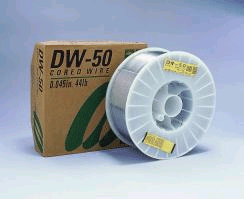
In contrast to stick welding, which has the flux on the surface of the electrode, a primary benefit of the flux cored wire is the wire's flux is protected by an outer steel sheath. Some wire sheaths have a straight butt seam and it's easy for them to allow moisture through the seam, other wires like the one in the picture have seams that are designed with a little more consideration for keeping moisture away from the flux. With flux cored wires you get what you pay for.
Gas shielded flux cored wires are supposed to be low hydrogen products, however that definition only applies as long as the weld wire is sealed in it's container. The flux in these wires or the wire surface can readily be be contaminated with moisture, and show me a ship yard where moisture is not an issue.
Ed's flux cored, and MIG weld process controls - best weld practice training programs available here also deal with the required best weld practices necessary for weld defect prevention.
WHAT IT TAKES TO GET HYDROGEN CRACKS STARTED:
[] High strength steels.
[] Large root gaps, plate misalignment, anything that results in excess weld heat and excess stresses.
[] Lack of control on the steel surface contaminates.
[] Lack of control with preheat and interpass temp controls.
[] Lack of history and protection for the flux cored weld consumables used.
[] Lack of awareness of the potential for moisture in the welding gases utilized
[] Lack of process and weld technique knowledge that could help minimize the effects of moisture
[] Lack of concern for the quality of the weld gases used. Many cylinders and pipes supplying MIG and flux cored weld gas mixes, will contain moisture.
WITHOUT BEST WELD PRACTICES AND PROCESS CONTROLS, WELD CRACKS WILL HAPPEN.
It's inevitable that on that on that one billion dollar naval vessel,containing high strength steels, that when that vessel leaves the docks, it will leave with hydrogen cracks.
To add misery to misery, the cracks will typically be in the weakened weld's heat affected zones, along side welds that are bound to contain lack of fusion, slag inclusions and extensive porosity.
INVESTIGATION OF FRACTURED STEEL PLATES REMOVED FROM WELDING SHIPS.Corporate Author : PENNSYLVANIA STATE UNIV UNIVERSITY PARK
Personal Author(s) : Williams, M. L. ; Meyerson, M. R. ; Kluge, G. L. ; Dale, L. R.
Abstract : Samples of fractured plates from 72 ships were examined, and various laboratory examinations and tests were made on 113 plates selected from these samples. Information regarding the structural failures involved was obtained from the cooperating agencies, and the failures were analysed on the basis of this information combined with the results of the laboratory investigations. The ship weld failures usually occurred at low temperatures, and the origin of the fractures could be traced, invariably, to a point of stress concentration at a geometrical or metallurgical notch resulting from design details or from welding defects.
Note from me: Fifty six years have passed since the above reports. When will ship yards get control of the common welding processes they utilize?
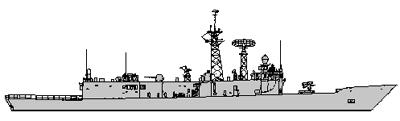
THE SUPERSTRUCTURE ON FFG 7 CLASS SHIPS HAS EXPERIENCED EXTENSIVE CRACKING. THE CAUSE OF THE CRACKING HAS BEEN DETERMINED TO BE A COMBINATION OF HIGH DESIGN STRESS COUPLED WITH POOR WELD QUALITY.
MANGEMENT THAT LACKHAD HANDS ON EXPERTISE WILL OFTEN TEND TO BE ADVISED BY SALESMEN...It was hard not to have a good laugh in 2005 when I read in the AWS magazine about some VP in a ship yard looking at purchasing a CO2 laser for ship welding applications. This was a yard I was familer with. It was a yard in which the management and engineers were unable to get control of the simple to use, two control, MIG - flux cored process. This was a yard where the managers had a difficult time getting their weld personnel to feel comfortable with simple Bug-O welds, (mechanized MIG or flux cored carriage welds). This was a yard in which none of the weld management understood the cost of a weld. This was a yard in which the managers and supervisors lacked the ability to provide edge preps and weld gaps that meet the design specifications for flux cored weld, and now this is a yard in which the management wants to to bring a laser into their yard.
IN MY WORLD, ANY SHIP YARD WOULD BE RUN LIKE A NAVY SHIP:
Ship yard management would do well to compare themselves with the way the navy runs a ship and submarine. A captain or engineer on these vessels typically has the ability to operate or take apart most things on the ship. I am not suggesting that today that this comprehensive, technical expertise should be part of this generation's manufacturing managers job description, (it should however be part of an engineers job description). I am suggesting that in 2012 the global weld industry would benefit from a compromise in which managers and engineers have less reliance on salesmen or weld equipment rep and show more ownership interest in the equipment responsible for building their products.
To get manufacturing management and engineers back into the weld equipment process control loop, an important first step would be for these individuals to show the workers that when they open their mouths on the subject of welding, they can provide welders on the shop floor something most don't have "weld process control knowledge".
If you are looking for excellent MIG and flux cored weld process control knowledge resource, it's here.
2001: SMAW AND MORE ON LACK OF EVOLUTION: The evolution from the shielded metal arc welding (stick) process, to the gas shielded flux cored welding process has for many pressure vessel shops, pipe shops and pipe line contractors been painful and slow. The flux cored wires that offered many practical benefits for all position welds were developed > twenty five ago. The weld reality for those industries that weld pipe lines or and code projects with the SMAW process, is the gas shielded flux cored weld process evolution for most all position code application should have taken a few weeks.
Some of the greatest resistance to the uses of flux cored wires came from the global pressure vessel and pipe weld shops that provide code quality welds. These weld shops like ship yards were entrenched in SMAW (stick) weld practices, and the unqualified flux cored sales reps who were selling the cored wires usually lacked the FCA weld process control - best weld practice expertise that was necessary to optimize the flux cored weld performance and therefore could not convince the stick pipe welders to accept the superior flux cored process. This in 2019 is an issue with introducing the worlds best weld process for pipe welds, its called TIP TIG.
As the majority of welders lack the best practices and weld process control expertise necessary for weld any weld consumable (or equip). evaluation, therefore the new consumable weld test results will often be poor. Also what motivation will welders have for going outside their daily comfort zones and recommending something new that would require major learning curve changes for both the weld shop and front office?OF COURSE MANAGENT WOULD BE HAPPY WITH A PROCESS THAT REQUIRES MINIMAL PROCESS CONTROL EXPERTISE:
As the SMAW equipment provides a single weld current control, the STICK welder simply increases or decreases the weld current and therefore needs minimal weld process control expertise. In most instances even the choice of the electrode is made for the welder. In contrast to the SMAW process, the MIG equipment that's also used for flux cored welding allows a welder to use seven distinct modes of weld transfer for MIG - FCA welds..The reality today in 2012 is that most of the weld shops that use the common MIG and flux cored processes will have focus on the welder's skills rather than on the welder's weld process control expertise. Every day in these weld shops you will find that the MIG equipment and consumables are rarely used to provide their full weld quality - productivity potential and therefore every day weld costs are more than they need to be. The upside is in most weld shops there is always good potential for dramatic weld cost savings.
WELDERS WILL NOT FEEL COMFORTABLE WITH WIRE FEED PROCESSES UNTIL SOME INDIVIDUAL IN THE COMPANY STEPS UP TO THE PLATE AND TEACHES THEM THE BEST PRACTICES AND PROCESS CONTROLS NECESSARY TO OPTIMIZE THESE TWO PROCESSES. PLEASE NOTE. YOU DO NOT NEED WELD EXPERTISE TO PRESENT MY UNIQUE WELD PROCESS CONTROL TRAINING RESOURCES.
WELDING SUBMARINES AND SPACE SHIPS WITHOUT WELD PROCESS CONTROLS?
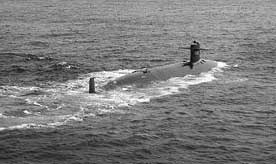
History of USS Thresher (SSN-593)
Related Resources:
In company with Skylark (ASR-20), the USS Thresher put to sea on 10 April 1963 for deep-diving exercises. In addition to her 16 officers and 96 enlisted men, the submarine carried 17 civilian technicians to observe her performance during the deep-diving tests. Fifteen minutes after reaching her assigned test depth, the submarine communicated with Skylark by underwater telephone, appraising the submarine rescue ship of difficulties. Garbled transmissions indicated that--far below the surface--things were going wrong. Suddenly, listeners in Skylark heard a noise "like air rushing into an air tank"--then, silence.
Efforts to reestablish contact with Thresher failed, and a search group was formed in an attempt to locate the submarine. Rescue ship Recovery (ASR-43) subsequently recovered bits of debris, including gloves and bits of internal insulation. Photographs taken by bathyscaph Trieste proved that the submarine had broken up, taking all hands on board to their deaths in 5,500 of water, some 220 miles east of Boston. Thresher was officially declared lost in April 1963.
Subsequently, a Court of Inquiry was convened and, after studying pictures and other data, they said that the loss of Thresher was in all probability due to a casting, piping, or weld failures that flooded the engine room with water. This water probably caused electrical failures that automatically shutdown the nuclear reactor, causing an initial power loss and the eventual loss of the boat.
How lack of metallurgical expertise and cold water helped destroy the Titanic.
Goverment weld - bld rework costs is often extraordinary.
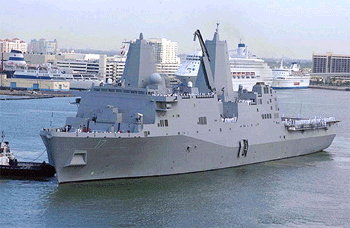
According to the program office the LPD 17 Amphibious Transport Dock, which was delivered to the Navy in July 2005, experienced numerous quality problems of varying degrees that significantly impacted the ship’s mission. These problems contributed to a delay of 3 years in the delivery of the ship and a cost increase of $846 million.In June 2007, the Secretary of the Navy sent a letter to the Chairman of the Board of Northrop Grumman expressing his concerns for the contractor’s ability to construct and deliver ships that conform to the quality standards maintained by the Navy and that adhere to the cost and schedule commitments agreed upon. Northrop Grumman’s Chairman acknowledged that the company was aware of the problems and is working on improving its processes.
The LPD 17 encountered a problem with the isolators on titanium piping. The isolators are used to separate different types of metals to keep them from corroding. The problem was discovered in 2006, about a year after the launch of the first ship. According to DOD program officials, the titanium piping is used throughout the ship because it is lighter than the traditional copper-nickel piping and has a longer service life. However, it has not been used much in naval surface ships or by the American shipbuilding industry, and therefore required new manufacturing and installation processes. According to the program office, these processes were being developed as Northrop Grumman Ship Systems was building the ship. In addition, designs for the piping hangers, which hold the piping in place, as well as tests of the isolators were subsequently delayed. When the titanium piping on the ship was changed, the hanger design had to be modified as well. The final hanger design was not completed until about 90 percent of the titanium piping was already on the ship, which resulted in additional rework and schedule delays.
(Note from Em. Welding Titanium would have been a much easier task with TIP TIG, which was available at this time.The ship alsp encountered problems with faulty welds on P-1 piping systems, a designation used in high-temperature, high-pressure, and other critical systems. This class of piping is used primarily in hydraulic applications in engineering and machinery spaces. P-1 piping systems require more extensive weld documentation than other pipes as they are part of critical systems and could cause significant damage to the ship and crew if they failed. Welds of this nature must be documented to ensure they were completed by qualified personnel and inspected for structural integrity. Further investigation revealed that weld inspection documentation was incomplete. As a result, increased rework levels were necessary to correct deficiencies and to re-inspect all the welds. Failure to complete this work would have increased the risk of weld failure and potentially presented a hazard to the ship and crew. According to the program office, a contributing factor was turnover in production personnel and their lack of knowledge on how to complete the proper documentation.
Note from Ed. If people are not doing their job, not qualified to do the job, it's time to hire qualified managers, engineers and supervisors who can rectify these situations and provide traimnig for their employees.
THIS NEXT ARTICLE INDICATES. WHY EVERY WELD SHOULD BE CONSIDERED A CRITICAL WELD:
Authors KITUNAI, Yoshio (Japan Crane Association)
KOBAYASHI, Hideo (Yokohama National University)
On March 27th, 1980, the semi-submersible platform Alexander Kielland suddenly capsized during a storm in the North Sea, because one of its five vertical columns supporting the platform was broken off. 123 workers among the 212 people on board were killed in the accident.
The investigation showed that a fatigue crack had propagated from the double fillet weld near the hydrophone mounted to the tubular bracing D6. As a result, the five other tubular bracings connecting to the vertical column D broke off due to overload, and the column D became separated from the platform. Consequently, the platform became unbalanced and capsized. After the accident, the offshore design rules were revised and some countermeasures were added to maintain a reserve of buoyancy and stability for a platform under a storm.
Cause (1) Fracture features
A circular hole was introduced to the underside of the D6 bracing, and a pipe, which is called a hydrophone, was mounted into the circular hole by welding. The hydrophone was 325 mm in diameter with a 26 mm wall thickness. The hydrophone was welded using a double fillet weld with a weld throat thickness of 6 mm. A drain of the bracing D6 had to be installed at a location 270 mm away from the hydrophone.
As a result of examination of the welds of the D6 bracing, some cracks related to lamellar tearing were found in the heat affected zone (HAZ) of the weld around the hydrophone. Traces of paint coinciding with the paint used on the platform were recognized on the fracture surface of the fillet weld around the hydrophone in the bracing D6.
The paint traces show that the cracks were already formed before the D6 bracing was painted. Examination of the fracture surface also showed that the fatigue cracks propagated from two initiation sites near the fillet weld of the hydrophone to the direction circumferential to the D6 bracing. Moreover, the fatigue fracture surface occupied more than 60% of the circumference of the D6 bracing (Fig. 7), and beach marks were formed on the fracture surface, which was about 60 to 100 mm away from the hydrophone. Striations with spacing of 0.25E-3 to 1.0 E-3 mm were observed in patches on the fracture surface of the D6 bracing.
(2) Characteristics of the welds of the hydrophone. Considering of the importance of the strength of the D6 bracing, welding of the drain into the bracing was carried out carefully according to the design rules. In the case of the installation of the hydrophone, however, a circular hole was made on the D6 bracing by gas cutting, and the surface of the hole was not treated by some process, such as a grinding. After cutting, a pipe, which was made by cold bending and welding using a plate with 20 mm thickness, was mounted into the hole of the bracing, and the pipe was attached by welded around the hole by double fillet welding with a throat thickness of 6 mm.
When the hydrophone was installed by welding, the weld defects, such as incomplete penetration, slag inclusion, and root cracks, were introduced in the welds, because of the poor gas cutting and welding practices. Moreover, lamellar tearing related to inclusions in the material used was found near the HAZ of the hydrophone. The stress concentration factor, Kt, of the fillet weld of the hydrophone was in the range of 2.5 to 3.0, which is higher than the average value of Kt of 1.6 for a fillet weld performed under normal conditions.
(3) Chemical composition and mechanical properties of materials
The chemical composition of the materials was found to be within the specified limits. A comparison of the mechanical properties between the specification and the test results for the fractured materials is shown in Table 2. The yield strength of the D6 bracing in the longitudinal direction is slightly lower than the specified minimum values. In case of the hydrophone, the Charpy impact energy is lower than the required value of 39 J at -40 C. Moreover, the reduction of area of the hydrophone for the through-thickness direction is markedly reduced because of the large amount of weld inclusions.
(1) Although the D6 bracing was one of primary components of the platform, little attention was given to the installation of the hydrophone into the bracing. Hence, a crack with a length of about 70 mm was introduced in the fillet weld around the hydrophone, before the D6 bracing was painted.
(2) Fatigue cracks propagated from two initiation sites near the fillet weld of the hydrophone in the direction circumferential to the D6 bracing at the early stage of the life of the platform.
(3) The five other bracings connected to the column D broke off due to overload, and the column D was separated from the platform. Consequently, the platform became unbalanced and capsized
(4) Inspection of the D6 bracing had not been carried out.
This is a partial report found on the web and it enpahasizes that all welds should be considered critical.
All http//weldreality.com weld programs