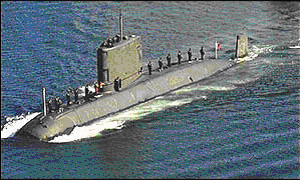
Her Majesty's Tireless Threatens Mediterranean
By John LaForge and Bonnie Urfer
"The most important thing we could do is…outlaw nuclear weapons to start with, then we outlaw nuclear reactors too. … I'm not proud of the part I played… I think we'll probably destroy ourselves." "-From Jan. 28, 1982 statement to U.S. Senate by Adm. Hyman Rickover, "father" of the U.S. nuclear navy."
GIBRALTAR-The near reactor meltdown aboard Britain's submarine Tireless, its spill of radioactive cooling water into the Mediterranean, and a risky, experimental and possibly illegal repair operation in a densely populated area, have brought thousands of outraged Gibraltar and Spanish residents into the streets. Since May 19, the 280-foot Tireless with its failed reactor has been docked near the center of Gibraltar, population 29,165.
According to the British Ministry of Defense (MOD), the Tireless' reactor failed May 12 while patrolling between Sicily and North Africa. One or more welds in the sub's primary cooling system cracked and began leaking hot, pressurized and radioactively contaminated water into the sea. Authorities initially claimed there was no danger of a radiation spill, but later admitted the leakage. Neither the Navy nor the MOD has said how much of the deadly wastewater was spewed.
Two major papers, the Sunday Times and the Guardian, have reported that Tireless came within "a few minutes" of a reactor meltdown when the high-pressure coolant began rushing out of the system. One Navy spokesperson said, "Once the fault had ripped through, it could not be isolated from the rest of the system." The Navy asserts that the reactor was properly shut down, but while Tireless was towed into the Bay of Algeciras the leak continued until, "Shortly after arriving [May 19] in Gibraltar the leak was temporarily sealed" (according to a Nov. 23 report by the hastily-assembled government Nuclear Safety Advisory Panel). Captain Dis Carneay quickly announced that Tireless would return to Britain for repairs. But on June 26 the MOD announced that repairs would take place at Gibraltar. No explanation was given for the change, except to say (in Nov.) that moving the sub "would introduce new, higher risks to the submarine, its crew and, possibly, to coastal communities." The decision to repair Tireless in Gibraltar violates Royal Navy procedure. The "Z" berths at Gibraltar are only for "recreational" stops. "These berths are not cleared for the maintenance or repair of the nuclear plant," according to Navy regulations. Gibraltar's berths have no permanent health physics department, no radiation monitoring organization and no disaster evacuation plans-all of which are required for the "X" berths built in Britain specifically for "refit, repair or maintenance of nuclear-powered warships.
Seven months later, the Tireless' worn out, leaking reactor still rests 1,800 meters from the desalination plant for Gibraltar's water supply. The Scottish Campaign for Nuclear Disarmament has protested that the geography of Gibraltar makes evacuation in the event of a radiation disaster difficult: the only land exit to the north could easily be within the contaminated area.
Risky, experimental repair
The Tireless uses a U.S.-designed pressurized water reactor built by Rolls Royce. In the reactor, primary cooling water flows directly over the extremely hot reactor fuel and then is pumped to a generator where it heats secondary water to create steam. Because the primary coolant circulates inside the reactor, it makes direct contact with intensely hot uranium fuel cladding, becoming radioactive.
When fuel cladding is damaged, cooling water is further contaminated with extremely deadly fission products, including plutonium-241, iodine-129, cesium-137, strontium-90, cobalt-60 and nickel-59 among others. If the Tireless' fuel cladding were damaged, some of these long-lived poisons would have poured into the sea for over a week. (Iodine-129 is dangerous for 150 million years; nickel-59 for 75,000.) Based on assurances by the MOD, the Advisory Panel claims that the cladding remains intact.
It took until the end of June for Tireless' reactor to cool down enough for inspection. The "2-mm wide crack" in a weld is said to be near the reactor vessel; the length of the crack was not divulged. The Navy has decided to completely remove a section of the heavy pipe and send it to England for study.
Still, the machinists didn't start the cutting and removal of the cracked ducting until Nov. 24. If the job was undertaken as announced, the three-day operation involved extremely dangerous and novel experiments:
1) Primary coolant was to be drained from the system for up to three weeks, leaving the reactor fuel at risk of overheating. The deliberately increased risk of a reactor meltdown was found by the Advisory Panel "to be acceptably low." (The Navy even convinced the panel that the fuel system is able to survive a complete loss of coolant.)
2) Some 24 cubic meters (6,340 gallons) of this primary cooling water was to be transferred to shore. And because Gibraltar's Z berth is not equipped with rad waste storage facilities, a containment system was cobbled together ad hoc. (The system will itself become contaminated waste.) The radioactive wastewater has already been on Gibraltar longer than the MOD's risk assessment suggested.
3) The section of failed welds was to be removed with a rig designed, built and tested for the first time. To replace the cracked pipe, the Navy intends to employ a welding method never used on nuclear reactors, a system that even the Advisory Panel found worrisome. "The Panel recognizes that having a direct path from the reactor to the outside environment places total reliance on the continued integrity of the fuel cladding to contain the fission products."
4) Finally, pressure testing of the primary loop, and restart of the reactor involve additional risks of leaks and fuel overheating.
Fleet withdrawal finds half the subs at risk
In late October, the British Navy recalled all of the Tireless' sister ships for reactor inspections. Defense Minister John Spellar admitted in the House of Commons that the reactor flaws on the Tireless might be "generic." A partial review of 12 Trafalgar and Swiftsure Class subs found six at risk of the same cooling system cracking. Five subs were cleared of the flaw, including HMS Triumph. Triumph, however, was on patrol and couldn't have undergone a thorough safety check since that requires a reactor shutdown.
Protests on the rise
Twelve thousand people marched Nov. 25 from La Linea in Spain (population 59,879), toward the submarine berth-only three kilometers away. The demonstrators demanded the removal and repair elsewhere of the crippled reactor. Some 1,500 marchers and boaters protested Aug. 15 near the Tireless' mooring, which is less than one mile from Gibraltar's major tourist attractions. Sept. 15, as most of the world's attention was focused on the sunken Russian sub Kursk, thousands filled the Plaza de la Constitucion in La Linea to declare the "Platform Against the Nuclear Submarine." Thousands protested July 13, declaring "Gibraltar isn't Europe's junkyard!"
Seven kilometers across the bay in the city of Algeciras-population 102,058-mayor Patricio Gonzalez has collected petitions intended for the courts in Gibraltar condemning the MOD's repair scheme and demanding an explanation of why the sub can't be towed back to Britain.
The protesters have howled at the government's emergency "preparedness" plan to dispense potassium iodate tablets after a radiation disaster.
The Progressive Foundation -- Nukewatch
P.O. Box 649
Luck, WI 54853
Phone: (715) 472-4185
Fax: (715) 472-4184.
Email: info@nukewatch.com
Website: www.nukewatch.com